
[Mar 12, 2026] ISO-IEC-27001-Lead-Auditor Test Prep Training Practice Exam Questions Practice Tests
Exam Questions Answers Braindumps ISO-IEC-27001-Lead-Auditor Exam Dumps PDF Questions
PECB ISO-IEC-27001-Lead-Auditor exam is an excellent opportunity for individuals to advance their careers in the field of information security management. PECB Certified ISO/IEC 27001 Lead Auditor exam certification is globally recognized and highly regarded in the industry. Successful completion of the exam demonstrates that an individual has the skills and knowledge necessary to lead an audit team and evaluate an organization's information security management system.
The PECB Certified ISO/IEC 27001 Lead Auditor exam certification exam assesses the candidate's understanding of the ISO/IEC 27001 standard, its requirements, and the best practices for implementing and maintaining an ISMS. It also evaluates the candidate's ability to plan, conduct, report, and follow-up on an audit. ISO-IEC-27001-Lead-Auditor exam covers topics such as risk management, incident management, asset management, and compliance with legal and regulatory requirements.
PECB ISO-IEC-27001-Lead-Auditor certification is highly valued by organizations looking for professionals who can help them achieve and maintain compliance with ISO/IEC 27001 standards. PECB Certified ISO/IEC 27001 Lead Auditor exam certification demonstrates that the holder has the necessary skills and knowledge to assess the effectiveness of an organization's ISMS and identify gaps that need to be addressed. It also shows that the holder is capable of conducting an audit that meets the requirements of ISO/IEC 27001 and delivering a report that provides valuable insights and recommendations.
NEW QUESTION # 181
ISMS (1)---------------helps determine (2)--------------,
- A. Q (1) Management review, (2) opportunities for continual improvement
- B. (1) Continual improvement, (2) the effectiveness of corrective actions
- C. (1) Internal audit, (2) the ISMS scope
Answer: A
Explanation:
Management review is a crucial component of an ISMS that helps determine opportunities for continual improvement. Through management review, an organization assesses the performance and effectiveness of its ISMS, including reviewing opportunities for improvements and the need for changes to the ISMS, including the security policy and security objectives.
NEW QUESTION # 182
You have just completed a scheduled information security audit of your organisation when the IT Manager approaches you and asks for your assistance in the revision of the company's risk management process.
He is attempting to update the current documentation to make it easier for other managers to understand, however, it is clear from your discussion he is confusing several key terms.
You ask him to match each of the descriptions with the appropriate risk term. What should the correct answers be?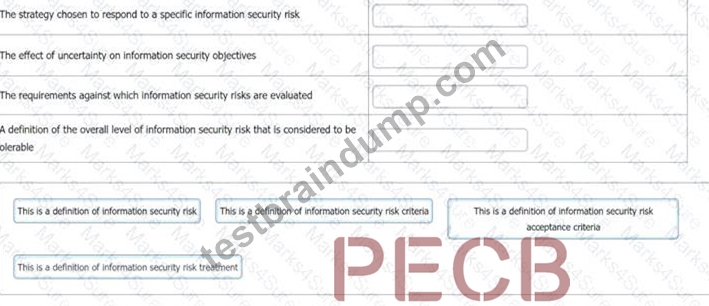
Answer:
Explanation: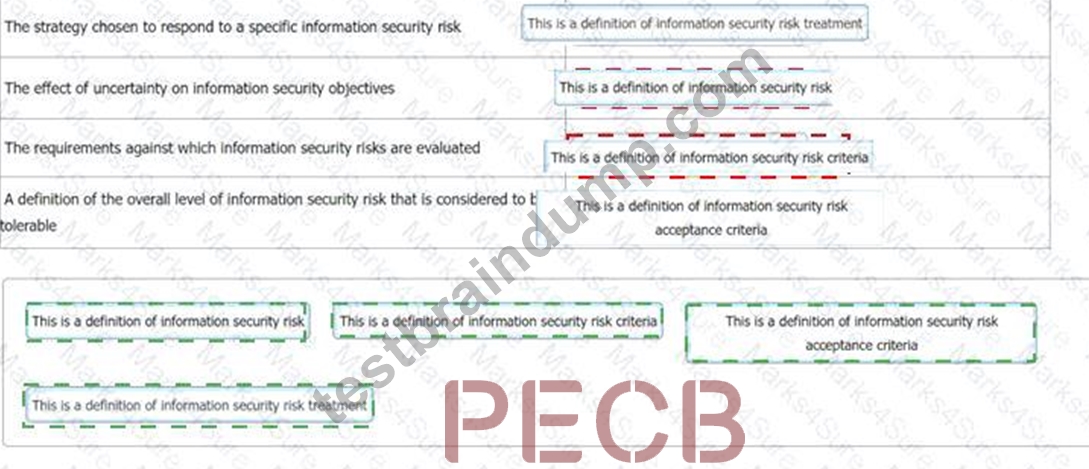
Explanation:
The correct answers for matching each of the descriptions with the appropriate risk term are:
* The strategy chosen to respond to a specific information security risk: This is a definition of information security risk treatment. According to ISO/IEC 27000:2022, information security risk treatment is "the process of selecting and implementing measures to modify the information security risk" Section 3.33.
* The effect of uncertainty on information security objectives: This is a definition of information security risk. According to ISO/IEC 27000:2022, information security risk is "the effect of uncertainty on information security objectives" Section 3.32.
* The requirements against which information security risks are evaluated: This is a definition of information security risk criteria. According to ISO/IEC 27000:2022, information security risk criteria are "the terms of reference by which the significance of information security risks is assessed" Section
3.31.
* A definition of the overall level of information security risk that is considered to be tolerable: This is a definition of information security risk acceptance criteria. According to ISO/IEC 27000:2022, information security risk acceptance criteria are "the level of information security risk that is acceptable" Section 3.30.
NEW QUESTION # 183
You are performing an ISMS initial certification audit at a residential nursing home that provides healthcare services. The next step in your audit plan is to conduct the closing meeting. During the final audit team meeting, as an audit team leader, you agree to report 2 minor nonconformities and 1 opportunity for improvement as below: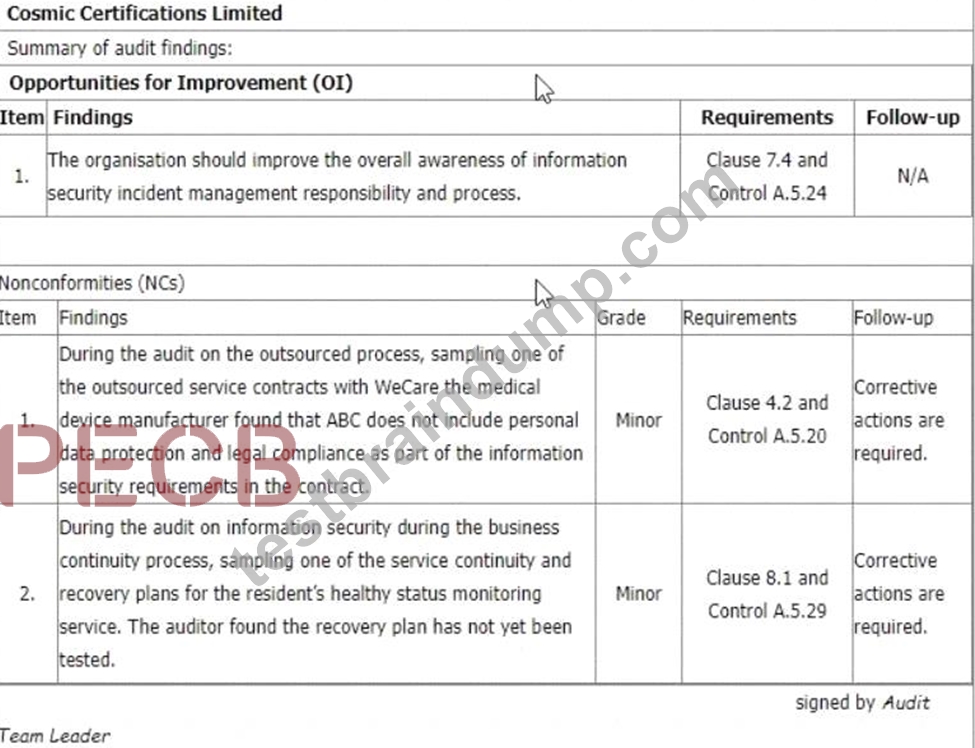
Select one option of the recommendation to the audit programme manager you are going to advise to the auditee at the closing meeting.
- A. Recommend that an unannounced audit is carried out at a future date
- B. Recommend certification immediately
- C. Recommend certification after your approval of the proposed corrective action plan Recommend that the findings can be closed out at a surveillance audit in 1 year
- D. Recommend that a partial audit is required within 3 months
- E. Recommend that a full scope re-audit is required within 6 months
Answer: C
Explanation:
Explanation
According to ISO/IEC 17021-1:2015, which specifies the requirements for bodies providing audit and certification of management systems, clause 9.4.9 requires the certification body to make a certification decision based on the information obtained during the audit and any other relevant information1. The certification body should also consider the effectiveness of the corrective actions taken by the auditee to address any nonconformities identified during the audit1. Therefore, when making a recommendation to the audit programme manager, an ISMS auditor should consider the nature and severity of the nonconformities and the proposed corrective actions.
Based on the scenario above, the auditor should recommend certification after their approval of the proposed corrective action plan and recommend that the findings can be closed out at a surveillance audit in 1 year. The auditor should provide the following justification for their recommendation:
Justification: This recommendation is appropriate because it reflects the fact that the auditee has only two minor nonconformities and one opportunity for improvement, which do not indicate a significant or systemic failure of their ISMS. A minor nonconformity is defined as a failure to achieve one or more requirements of ISO/IEC 27001:2022 or a situation which raises significant doubt about the ability of an ISMS process to achieve its intended output, but does not affect its overall effectiveness or conformity2. An opportunity for improvement is defined as a suggestion for improvement beyond what is required by ISO/IEC 27001:20222. Therefore, these findings do not prevent or preclude certification, as long as they are addressed by appropriate corrective actions within a reasonable time frame. The auditor should approve the proposed corrective action plan before recommending certification, to ensure that it is realistic, achievable, and effective. The auditor should also recommend that the findings can be closed out at a surveillance audit in 1 year, to verify that the corrective actions have been implemented and are working as intended.
The other options are not valid recommendations for the audit programme manager, as they are either too lenient or too strict for the given scenario. For example:
Recommend certification immediately: This option is not valid because it implies that the auditor ignores or accepts the nonconformities, which is contrary to the audit principles and objectives of ISO
19011:20182, which provides guidelines for auditing management systems. It also contradicts the requirement of ISO/IEC 17021-1:20151, which requires the certification body to consider the effectiveness of the corrective actions taken by the auditee before making a certification decision.
Recommend that a full scope re-audit is required within 6 months: This option is not valid because it implies that the auditor overreacts or exaggerates the nonconformities, which is contrary to the audit principles and objectives of ISO 19011:20182. It also contradicts the requirement of ISO/IEC
17021-1:20151, which requires the certification body to determine whether a re-audit is necessary based on the nature and extent of nonconformities and other relevant factors. A full scope re-audit is usually reserved for major nonconformities or multiple minor nonconformities that indicate a serious or widespread failure of an ISMS.
Recommend that an unannounced audit is carried out at a future date: This option is not valid because it implies that the auditor distrusts or doubts the auditee's commitment or capability to implement corrective actions, which is contrary to the audit principles and objectives of ISO 19011:20182. It also contradicts the requirement of ISO/IEC 17021-1:20151, which requires the certification body to conduct unannounced audits only under certain conditions, such as when there are indications of serious problems with an ISMS or when required by sector-specific schemes.
Recommend that a partial audit is required within 3 months: This option is not valid because it implies that the auditor imposes or prescribes a specific time frame or scope for verifying corrective actions, which is contrary to the audit principles and objectives of ISO 19011:20182. It also contradicts the requirement of ISO/IEC 17021-1:20151, which requires the certification body to determine whether a partial audit is necessary based on the nature and extent of nonconformities and other relevant factors. A partial audit may be appropriate for minor nonconformities, but the time frame and scope should be agreed upon with the auditee and based on the proposed corrective action plan.
References: ISO/IEC 17021-1:2015 - Conformity assessment - Requirements for bodies providing audit and certification of management systems - Part 1: Requirements, ISO 19011:2018 - Guidelines for auditing management systems
NEW QUESTION # 184
Which two of the following are examples of audit methods that 'do not' involve human interaction?
- A. Reviewing the auditee's response to an audit finding
- B. Analysing data by remotely accessing the auditee's server
- C. Confirming the date and time of the audit
- D. Conducting an interview using a teleconferencing platform
- E. Performing a review of auditees procedures in preparation for an audit
- F. Observing work performed by remote surveillance
Answer: B,E
Explanation:
Audit methods are the techniques and procedures that auditors use to collect and evaluate audit evidence. Audit methods can be classified into two categories: those that involve human interaction and those that do not. Human interaction methods are those that require direct or indirect communication with the auditee or other relevant parties, such as interviews, questionnaires, surveys, observations, or walkthroughs. Non-human interaction methods are those that do not require any communication with the auditee or other parties, such as document reviews, data analysis, or remote surveillance.
Some examples of audit methods that do not involve human interaction are:
Performing a review of auditee's procedures in preparation for an audit: This method involves examining the auditee's documented information, such as policies, processes, records, or reports, to verify their adequacy and effectiveness in meeting the audit criteri a. The auditor does not need to interact with the auditee or anyone else to perform this method.
Analysing data by remotely accessing the auditee's server: This method involves accessing and processing the auditee's data, such as performance indicators, logs, metrics, or statistics, to verify their accuracy and reliability in meeting the audit criteria. The auditor does not need to interact with the auditee or anyone else to perform this method.
Reference:
ISO/IEC 27001:2022 Lead Auditor (Information Security Management Systems) objectives and content from Quality.org and PECB ISO 19011:2018 Guidelines for auditing management systems [Section 6.2.2]
NEW QUESTION # 185
Which two of the following statements are true?
- A. As part of a certification body audit the auditor is resporable for verifying the organisation's legal compliance status
- B. Curing a third-party audit, the auditor evaluates how the organisation ensures that 4 6 made aware of changes to the legal requirements
- C. The role of a certification body auditor involves evaluating the organisation's processes for ensuring compliance with their legal requirements
Answer: B,C
Explanation:
The following statements are true:
* The role of a certification body auditor involves evaluating the organization's processes for ensuring compliance with their legal requirements. This is part of the auditor's responsibility to assess the effectiveness and conformity of the organization's ISMS against the ISO/IEC 27001:2022 standard and the applicable legal and regulatory requirements.
* During a third-party audit, the auditor evaluates how the organization ensures that they are made aware of changes to the legal requirements. This is part of the auditor's responsibility to verify that the
* organization has established and maintained a process for identifying and updating their legal and other requirements related to information security. The following statement is false:
* As part of a certification body audit, the auditor is responsible for verifying the organization's legal compliance status. This is not true, as the auditor is not authorized or qualified to provide legal advice or judgment on the organization's compliance status. The auditor can only report on the evidence of compliance or noncompliance observed during the audit, but the ultimate responsibility for ensuring legal compliance lies with the organization. References: : CQI & IRCA ISO 27001:2022 Lead Auditor Course Handbook, page 66. : CQI & IRCA ISO 27001:2022 Lead Auditor Course Handbook, page 67.: ISO/IEC 27001 LEAD AUDITOR - PECB, page 22.
NEW QUESTION # 186
In the context of a management system audit, please identify the sequence of a typical process of collecting and verifying information. The first one has been done for you.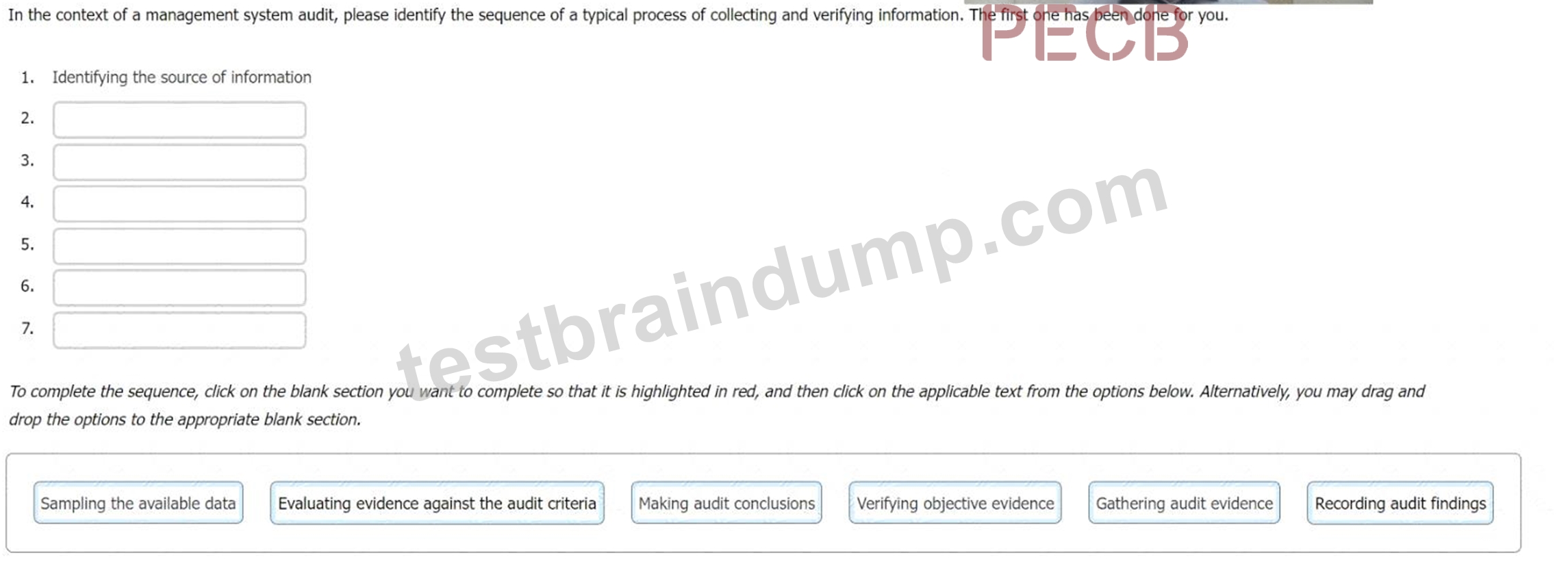
Answer:
Explanation: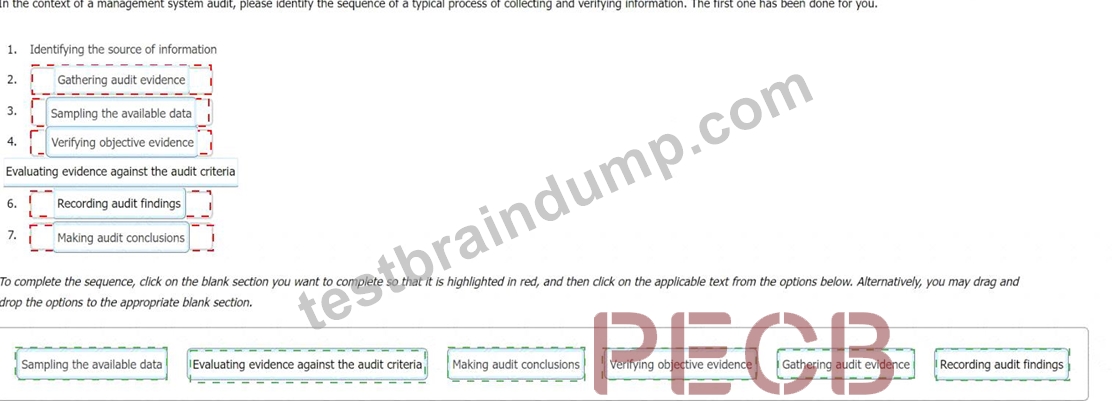
Explanation
A screenshot of a computer Description automatically generated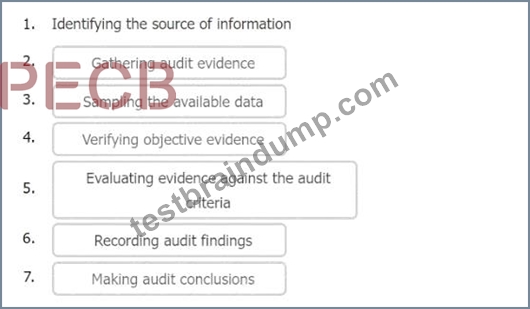
* Identifying the source of information (already given)
* Gathering audit evidence: This involves collecting information from various sources such as documents, records, interviews, and observations.
* Sampling the available data: Due to the vast amount of information available, auditors typically use sampling techniques to select representative data for closer scrutiny.
* Verifying objective evidence: This involves checking the accuracy, completeness, and reliability of the collected evidence.
* Evaluating evidence against the audit criteria: Auditors compare the collected evidence to the established criteria (e.g., standards, policies, procedures) to assess compliance and effectiveness.
* Recording audit findings: This involves documenting the results of the evaluation, including observations, conclusions, and recommendations.
* Making audit conclusions: Based on the recorded findings, auditors formulate overall conclusions about the status of the management system.
Therefore, the correct sequence is:
1. Identifying the source of information 2. Gathering audit evidence 3. Sampling the available data 4.
Verifying objective evidence 5. Evaluating evidence against the audit criteria 6. Recording audit findings 7.
Making audit conclusions
NEW QUESTION # 187
You ask the IT Manager why the organisation still uses the mobile app while personal data encryption and pseudonymization tests failed. Also, whether the Service Manager is authorized to approve the test.
The IT Manager explains the test results should be approved by him according to the software security management procedure. The reason why the encryption and pseudonymization functions failed is that these functions heavily slowed down the system and service performance. An extra 150% of resources are needed to cover this. The Service Manager agreed that access control is good enough and acceptable. That's why the Service Manager signed the approval.
You sample one of the medical staff's mobile and found that ABC's healthcare mobile app, version 1.01 is installed. You found that version 1.01 has no test record.
The IT Manager explains that because of frequent ransomware attacks, the outsourced mobile app development company gave a free minor update on the tested software, performed an emergency release of the updated software, and gave a verbal guarantee that there will be no impact on any security functions. Based on his 20 years of information security experience, there is no need to re-test.
You are preparing the audit findings Select two options that are correct.
- A. There is NO nonconformity (NC). The IT Manager demonstrates he is fully competent. (Relevant to clause 7.2)
- B. There is an opportunity for improvement (OI). The IT Manager should make the decision to continue the service based on appropriate testing. (Relevant to clause 8.1, control A.8.30)
- C. There is an opportunity for improvement (OI). The organisation selects an external service provider based on the extent of free services it will provide. (Relevant to clause 8.1, control A.5.21)
- D. There is NO nonconformity (NC). The IT Manager demonstrates good leadership. (Relevant to clause
5.1, control 5.4) - E. There is a nonconformity (NC). The organisation does not control planned changes and review the consequences of unintended changes. (Relevant to clause 8.1)
- F. There is a nonconformity (NC). The IT Manager does not comply with the software security management procedure. (Relevant to clause 8.1, control A.8.30)
Answer: E,F
Explanation:
Explanation
According to ISO 27001:2022 Annex A Control 8.30, the organisation shall ensure that externally provided processes, products or services that are relevant to the information security management system are controlled. This includes developing and entering into licensing agreements that cover code ownership and intellectual property rights, and implementing appropriate contractual requirements related to secure design and coding in accordance with Annex A 8.25 and 8.2912 In this case, the organisation and the developer have performed security tests that failed, which indicates that the secure design and coding requirements of Annex A 8.29 were not met. The IT Manager explains that the encryption and pseudonymization functions failed because they slowed down the system and service performance, and that an extra 150% of resources are needed to cover this. However, this does not justify the acceptance of the test results by the Service Manager, who is not authorised to approve the test according to the software security management procedure. The Service Manager should have consulted with the IT Manager, who is the owner of the process, and followed the procedure for handling nonconformities and corrective actions. The Service Manager's decision to continue the service based on access control alone exposes the organisation to the risk of compromising the confidentiality, integrity, and availability of personal data processed by the mobile app. Therefore, there is a nonconformity (NC) with clause 8.1, control A.8.30.
According to ISO 27001:2022 Clause 8.1, the organisation shall plan, implement and control the processes needed to meet information security requirements, and to implement the actions determined in Clause 6.1. The organisation shall also control planned changes and review the consequences of unintended changes, taking action to mitigate any adverse effects, as necessary12 In this case, the organisation has not controlled the planned change of the mobile app from version 1.0 to version 1.01, which was a minor update provided by the outsourced developer in response to frequent ransomware attacks. The IT Manager explains that the developer performed an emergency release of the updated software, and gave a verbal guarantee that there will be no impact on any security functions.
However, this is not sufficient to ensure that the change is properly assessed, tested, documented, and approved before deployment. The IT Manager should have followed the change management process and procedure, and verified that the updated software meets the security requirements and does not introduce any new vulnerabilities or risks. The IT Manager's reliance on his 20 years of information security experience and the developer's verbal guarantee is not a valid basis for skipping the re-testing of the software. Therefore, there is a nonconformity (NC) with clause 8.1.
References:
1: ISO/IEC 27001:2022 Lead Auditor (Information Security Management Systems) Course by CQI and IRCA Certified Training 1 2: ISO/IEC 27001 Lead Auditor Training Course by PECB 2
NEW QUESTION # 188
You are an ISMS audit team leader tasked with conducting a follow-up audit at a client's data centre. Following two days on-site you conclude that of the original 12 minor and 1 major nonconformities that prompted the follow-up audit, only 1 minor nonconformity still remains outstanding.
Select four options for the actions you could take.
- A. Recommend suspension of the organisation's certification as they have failed to implement the agreed corrections and corrective actions within the agreed timescale
- B. Agree with the auditee/audit client how the remaining nonconformity will be cleared, by when, and how its clearance will be verified
- C. Book another follow-up audit on-site to review the one outstanding minor nonconformity once it has been cleared
- D. Advise the auditee that you will arrange an online audit to deal with the outstanding nonconformity
- E. Close the follow-up audit as the organisation has demonstrated it is committed to clearing the nonconformities raised
- F. Note the progress made but hold the audit open until all corrective action has been cleared
- G. Recommend that the outstanding minor nonconformity is dealt with at the next surveillance audit
- H. Advise the individual managing the audit programme of any decision taken regarding the outstanding nonconformity
Answer: B,E,G,H
Explanation:
According to ISO 19011:2018, which provides guidelines for auditing management systems, clause 6.7 requires the audit team leader to conduct a follow-up audit to verify the implementation and effectiveness of the corrective actions taken by the auditee in response to the nonconformities identified during a previous audit1. The follow-up audit should be conducted in accordance with the same principles and processes as the initial audit, and should result in a conclusion on the status of the nonconformities and any remaining issues1. Therefore, when conducting a follow-up audit, an ISMS auditor should consider the following actions:
Recommend that the outstanding minor nonconformity is dealt with at the next surveillance audit: This action is appropriate because it reflects the fact that the auditee has cleared most of the nonconformities, including the major one, and only one minor nonconformity remains outstanding. A minor nonconformity is defined as a failure to achieve one or more requirements of ISO/IEC 27001:2022 or a situation which raises significant doubt about the ability of an ISMS process to achieve its intended output, but does not affect its overall effectiveness or conformity2. Therefore, this finding does not prevent or preclude the continuation of certification, as long as it is addressed by appropriate corrective actions within a reasonable time frame. The auditor should recommend that the outstanding minor nonconformity is dealt with at the next surveillance audit, which is a regular audit conducted by the certification body to confirm the ongoing conformity and effectiveness of an ISMS3.
Agree with the auditee/audit client how the remaining nonconformity will be cleared, by when, and how its clearance will be verified: This action is appropriate because it reflects the fact that the auditee has demonstrated commitment and capability to implement corrective actions for the nonconformities identified during the previous audit. The auditor should agree with the auditee/audit client on a realistic, achievable, and effective corrective action plan for the remaining nonconformity, including a clear deadline and verification method. The auditor should also document this agreement in the follow-up audit report1.
Advise the individual managing the audit programme of any decision taken regarding the outstanding nonconformity: This action is appropriate because it reflects the fact that the auditor has followed a systematic and consistent approach to conducting and reporting the follow-up audit. The auditor should advise the individual managing the audit programme of any decision taken regarding the outstanding nonconformity, such as recommending its closure at the next surveillance audit or agreeing on a corrective action plan with the auditee/audit client. The auditor should also provide sufficient information and evidence to support their decision1.
Close the follow-up audit as the organisation has demonstrated it is committed to clearing the nonconformities raised: This action is appropriate because it reflects the fact that the organisation has achieved satisfactory results in the follow-up audit. The auditor should close the follow-up audit as the organisation has demonstrated it is committed to clearing the nonconformities raised by implementing effective corrective actions for most of them and agreeing on a plan for the remaining one. The auditor should also communicate the follow-up audit conclusion to the auditee/audit client and other relevant parties1.
NEW QUESTION # 189
Which two of the following are examples of audit methods that 'do' involve human interaction?
- A. Analysing data by remotely accessing the auditee's server
- B. Analysing data by remotely accessing the auditee's server
- C. Performing an independent review of procedures in preparation for an audit
- D. Observing work performed by remote surveillance
- E. Reviewing the auditee's response to an audit finding
Answer: C,E
Explanation:
Audit methods are techniques used by auditors to obtain audit evidence. Audit methods can be classified into two categories: those that involve human interaction and those that do not2. Audit methods that involve human interaction require direct communication between the auditor and the auditee or other relevant parties, such as interviews, questionnaires, surveys, meetings, etc. Audit methods that do not involve human interaction rely on observation, inspection, measurement, testing, sampling, analysis, etc., without requiring any verbal or written exchange2. Therefore, performing an independent review of procedures in preparation for an audit and reviewing the auditee's response to an audit finding are examples of audit methods that involve human interaction, as they require reading and evaluating documents provided by the auditee or other sources. On the other hand, analysing data by remotely accessing the auditee's server and observing work performed by remote surveillance are examples of audit methods that do not involve human interaction, as they do not require any direct communication with the auditee or other parties. References: ISO/IEC 27001:2022 Lead Auditor (Information Security Management Systems) | CQI | IRCA
NEW QUESTION # 190
During a third-party certification audit, you are presented with a list of issues by an auditee. Which four of the following constitute 'internal' issues in the context of a management system to ISO 27001:2022?
- A. Inability to source raw materials due to government sanctions
- B. A reduction in grants as a result of a change in government policy
- C. A rise in interest rates in response to high inflation
- D. A fall in productivity linked to outdated production equipment
- E. Higher labour costs as a result of an aging population
- F. Poor levels of staff competence as a result of cuts in training expenditure
- G. Increased absenteeism as a result of poor management
- H. Poor morale as a result of staff holidays being reduced
Answer: D,F,G,H
NEW QUESTION # 191
Which is an example of a qualitative evidence?
- A. A defined sample analysis of nonconformity reports drafted by the audited organization from the time their ISMS was implemented
- B. The documented results of an intrusion-detection test from an information security expert from an external organization
- C. An interview with the information security personnel to validate if the information security process complies with the standard requirements
Answer: C
Explanation:
Qualitative evidence in an audit typically involves observations, interviews, and reviews that provide insights into the processes and compliance through subjective but informed assessments. An interview with information security personnel to validate compliance with the standard requirements is an example of qualitative evidence, where the quality and effectiveness of processes are assessed based on expert judgments rather than measurable metrics.
References: PECB ISO/IEC 27001 Lead Auditor Course Material
NEW QUESTION # 192
Which one of the following options describes the main purpose of a Stage 1 audit?
- A. To compile the audit plan
- B. To get to know the organisation
- C. To determine readiness for Stage 2
- D. To check for legal compliance by the organisation
Answer: C
Explanation:
The main purpose of a Stage 1 audit is to evaluate the adequacy and effectiveness of the organisation's ISMS documentation, and to assess whether the organisation is prepared for the Stage 2 audit, where the implementation and operation of the ISMS will be verified. The Stage 1 audit also involves verifying the scope, objectives, and context of the ISMS, as well as identifying any areas of concern or nonconformities that need to be addressed before the Stage 2 audit.
References:
ISO/IEC 27001:2022 Lead Auditor (Information Security Management Systems) objectives and content from Quality.org and PECB ISO/IEC 27006:2015 Information technology - Security techniques - Requirements for bodies providing audit and certification of information security management systems Section 7.3.1
NEW QUESTION # 193
Select the words that best complete the sentence:
"The purpose of maintaining regulatory compliance in a management system is to To complete the sentence with the best word(s), click on the blank section you want to complete so that it is highlighted in red, and then click on the applicable text from the options below. Alternatively, you may drag and drop the option to the appropriate blank section.
Answer:
Explanation:
Explanation:
According to ISO 27001:2013, clause 5.2, the top management of an organization must establish, implement and maintain an information security policy that is appropriate to the purpose of the organization and provides a framework for setting information security objectives. The information security policy must also include a commitment to comply with the applicable legal, regulatory and contractual requirements, as well as any other requirements that the organization subscribes to. Therefore, maintaining regulatory compliance is part of fulfilling the management system policy and ensuring its effectiveness and suitability. References:
* ISO/IEC 27001:2013, Information technology - Security techniques - Information security management systems - Requirements, clause 5.2
* PECB Candidate Handbook ISO 27001 Lead Auditor, page 10
* ISO 27001 Policy: How to write it according to ISO 27001
NEW QUESTION # 194
You are an experienced ISMS audit team leader providing guidance to an ISMS auditor in training. They have been asked to carry out an assessment of external providers and have prepared a checklist containing the following activities. They have asked you to review their checklist to confirm that the actions they are proposing are appropriate.
The audit they have been invited to participate in is a third-party surveillance audit of a data centre . The data centre agent is part of a wider telecommunication group. Each data centre within the group operates its own ISMS and holds its own certificate.
Select three options that relate to ISO/IEC 27001:2022's requirements regarding external providers.
- A. I will check the other data centres are treated as external providers, even though they are part of the same telecommunication group
- B. I will ensure the organization is has determined the need to communicate with external providers regarding the ISMS
- C. I will limit my audit activity to externally provided processes as there is no need to audit externally provided products of services
- D. I will ensure external providers have a documented process in place to notify the organisation of any risks arising from the use of its products or services
- E. I will ensure that the organisation ranks its external providers and allocates the majority of its work to those providers who are rated the highest
- F. I will ensure that top management have assigned roles and responsibilities for those providing external ISMS processes as well as internal ISMS processes
- G. I will ensure that the organisation has a reserve external provider for each process it has identified as critical to preservation of the confidentiality, integrity and accessibility of its information
- H. I will ensure the organization is regularly monitoring, reviewing and evaluating external provider performance
Answer: A,D,H
Explanation:
* A. I will check the other data centres are treated as external providers, even though they are part of the same telecommunication group. This is appropriate because clause 8.1.4 of ISO 27001:2022 requires the organisation to ensure that externally provided processes, products or services that are relevant to the information security management system are controlled. Externally provided processes, products or services are those that are provided by any external party, regardless of the degree of its relationship with the organisation. Therefore, the other data centres within the same telecommunication group should be treated as external providers and subject to the same controls as any other external provider12
* B. I will ensure external providers have a documented process in place to notify the organisation of any risks arising from the use of its products or services. This is appropriate because clause 8.1.4 of ISO
27001:2022 requires the organisation to implement appropriate contractual requirements related to information security with external providers. One of the contractual requirements could be the obligation of the external provider to notify the organisation of any risks arising from the use of its products or services, such as security incidents, vulnerabilities, or changes that could affect the information security of the organisation. The external provider should have a documented process in place to ensure that such notification is timely, accurate, and complete12
* E. I will ensure the organisation is regularly monitoring, reviewing and evaluating external provider performance. This is appropriate because clause 8.1.4 of ISO 27001:2022 requires the organisation to monitor, review and evaluate the performance and effectiveness of the externally provided processes, products or services. The organisation should have a process in place to measure and verify the conformity and suitability of the external provider's deliverables and activities, and to provide feedback and improvement actions as necessary. The organisation should also maintain records of the monitoring, review and evaluation results12
* F. I will ensure the organisation has determined the need to communicate with external providers regarding the ISMS. This is appropriate because clause 7.4.2 of ISO 27001:2022 requires the organisation to determine the need for internal and external communications relevant to the information security management system, including the communication with external providers. The organisation should define the purpose, content, frequency, methods, and responsibilities for such communication, and ensure that it is consistent with the information security policy and objectives. The organisation should also retain documented information of the communication as evidence of its implementation12 The following activities are not appropriate for the assessment of external providers according to ISO 27001:
2022:
* C. I will ensure that the organisation has a reserve external provider for each process it has identified as critical to preservation of the confidentiality, integrity and accessibility of its information. This is not appropriate because ISO 27001:2022 does not require the organisation to have a reserve external provider for each critical process. The organisation may choose to have a contingency plan or a backup solution in case of failure or disruption of the external provider, but this is not a mandatory requirement. The organisation should assess the risks and opportunities associated with the external provider and determine the appropriate treatment options, which may or may not include having a reserve external provider12
* D. I will limit my audit activity to externally provided processes as there is no need to audit externally provided products or services. This is not appropriate because clause 8.1.4 of ISO 27001:2022 requires the organisation to control the externally provided processes, products or services that are relevant to the information security management system. Externally provided products or services may include software, hardware, data, or cloud services that could affect the information security of the organisation. Therefore, the audit activity should cover both externally provided processes and products or services, as applicable12
* G. I will ensure that top management have assigned roles and responsibilities for those providing external ISMS processes as well as internal ISMS processes. This is not appropriate because clause 5.3 of ISO 27001:2022 requires the top management to assign the roles and responsibilities for the information security management system within the organisation, not for the external providers. The external providers are responsible for assigning their own roles and responsibilities for the processes, products or services they provide to the organisation. The organisation should ensure that the external providers have adequate competence and awareness for their roles and responsibilities, and that they are contractually bound to comply with the information security requirements of the organisation12
* H. I will ensure that the organisation ranks its external providers and allocates the majority of its work to those providers who are rated the highest. This is not appropriate because ISO 27001:2022 does not require the organisation to rank its external providers or to allocate its work based on such ranking. The organisation may choose to evaluate and compare the performance and effectiveness of its external providers, but this is not a mandatory requirement. The organisation should select and use its external providers based on the information security criteria and objectives that are relevant to the organisation12 References:
1: ISO/IEC 27001:2022 Lead Auditor (Information Security Management Systems) Course by CQI and IRCA Certified Training 1 2: ISO/IEC 27001 Lead Auditor Training Course by PECB 2
NEW QUESTION # 195
You are an experienced ISMS audit team leader providing guidance to an auditor in training.
The auditor in training appears to be confused about the interpretation of competence in ISO 27001:2022 and is seeking clarification from you that his understanding is correct. He sets out a series of mini scenarios and asks you which of these you would attribute to a lack of competence. Select four correct options.
- A. A data centre operator inadvertently placed a backup tape into an incorrect drive because they were in a hurry to move on to another task
- B. An IT technician failed to configure a new model of server correctly as a result of not reading the supplied instructions
- C. An experienced receptionist allowed a contractor she recognised to enter the data centre without his access card
- D. A senior programmer did not check their coding for errors as they were running late for a doctor's appointment
- E. An employee recently transferred from the IT networks team to Software development was unaware of the need to complete product release forms prior to shipping
- F. A system administrator deleted two live accounts as well as five redundant accounts as a result of receiving an incorrect instruction
- G. A senior manager could not assist in the organisation's information security incident recovery process as she had not received the required training
- H. A new starter was unable to switch on CCTV monitoring because they had not been shown how to do this
Answer: B,E,G,H
Explanation:
Explanation
These four scenarios are examples of a lack of competence, which is defined as the ability to apply the knowledge and skills needed to perform a work role or a task effectively and efficiently12. Competence in ISO
27001:2022 is determined by the organisation's needs and expectations, and it is based on the relevant education, training, or experience of the people involved in the ISMS34. The organisation is required to ensure that all the people who affect the performance of the ISMS are competent, and to provide them with the necessary training and awareness to fulfil their roles and responsibilities35. The four scenarios indicate that the people involved either lack the knowledge or skills to perform their tasks, or have not received the appropriate training or guidance to do so. The other scenarios are not related to competence, but to other factors such as negligence, error, or policy violation.
References: = 1: ISO 19011:2018 Guidelines for auditing management systems, clause 3.72: ISO/IEC
27007:2011 Information technology - Security techniques - Guidelines for information security management systems auditing, clause 53: ISO/IEC 27001:2022 Information technology - Security techniques
- Information security management systems - Requirements, clause 7.24: ISO 27001 Requirement 7.2 - Competence | ISMS.online15: ISO27001 Clause 7.2 Competence - Ultimate Certification Guide - High Table3
NEW QUESTION # 196 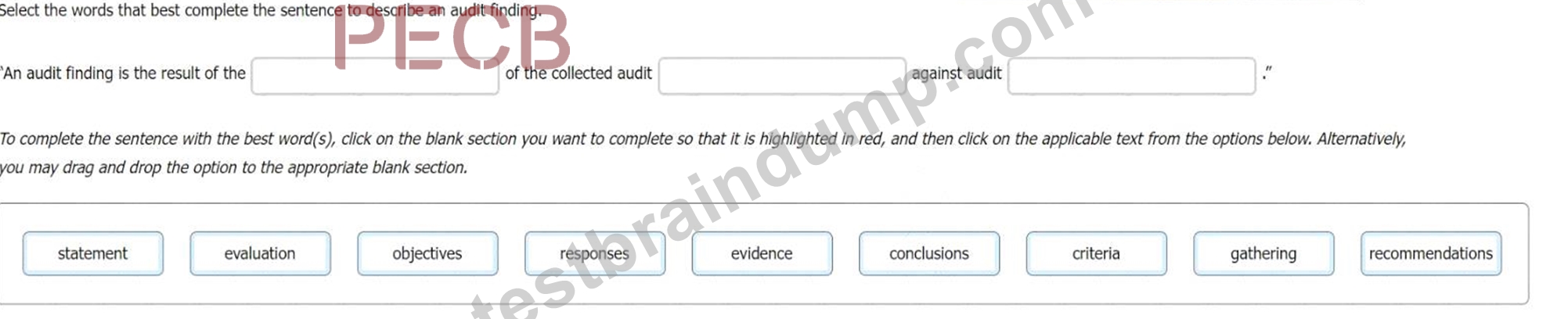
Answer:
Explanation: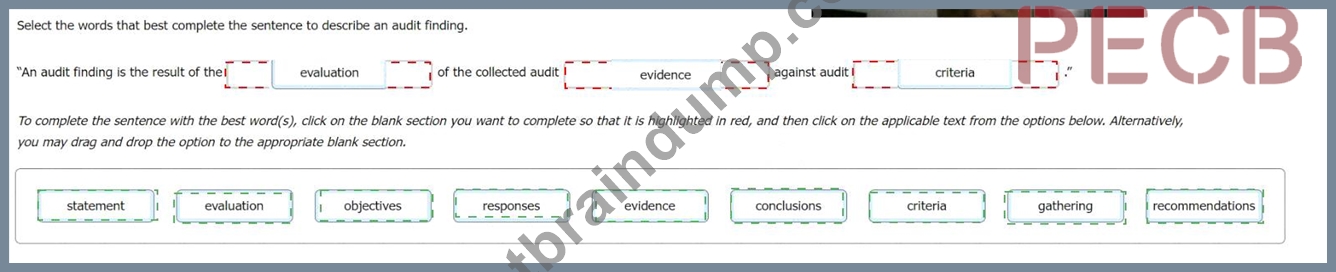
Explanation:
An audit finding is the result of the evaluation of the collected audit evidence against audit criteria.
NEW QUESTION # 197
You are performing an ISMS initial certification audit at a residential nursing home that provides healthcare services. The next step in your audit plan is to conduct the closing meeting. During the final audit team meeting, as an audit team leader, you agree to report 2 minor nonconformities and 1 opportunity for improvement as below: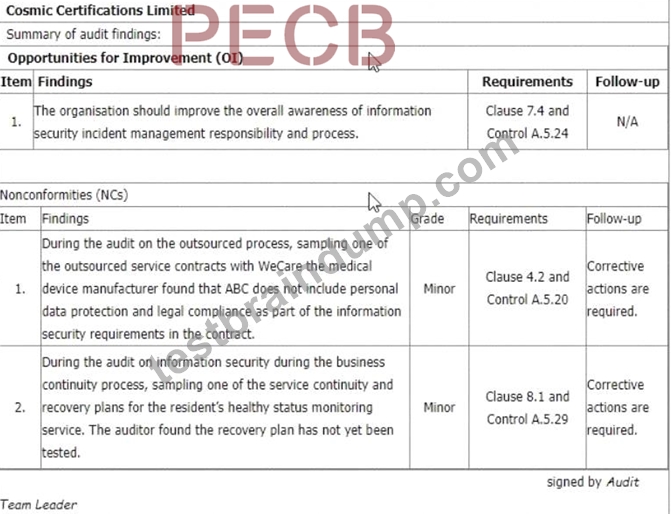
Select one option of the recommendation to the audit programme manager you are going to advise to the auditee at the closing meeting.
- A. Recommend that an unannounced audit is carried out at a future date
- B. Recommend certification immediately
- C. Recommend certification after your approval of the proposed corrective action plan Recommend that the findings can be closed out at a surveillance audit in 1 year
- D. Recommend that a partial audit is required within 3 months
- E. Recommend that a full scope re-audit is required within 6 months
Answer: C
Explanation:
Explanation
According to ISO/IEC 17021-1:2015, which specifies the requirements for bodies providing audit and certification of management systems, clause 9.4.9 requires the certification body to make a certification decision based on the information obtained during the audit and any other relevant information1. The certification body should also consider the effectiveness of the corrective actions taken by the auditee to address any nonconformities identified during the audit1. Therefore, when making a recommendation to the audit programme manager, an ISMS auditor should consider the nature and severity of the nonconformities and the proposed corrective actions.
Based on the scenario above, the auditor should recommend certification after their approval of the proposed corrective action plan and recommend that the findings can be closed out at a surveillance audit in 1 year. The auditor should provide the following justification for their recommendation:
* Justification: This recommendation is appropriate because it reflects the fact that the auditee has only two minor nonconformities and one opportunity for improvement, which do not indicate a significant or systemic failure of their ISMS. A minor nonconformity is defined as a failure to achieve one or more requirements of ISO/IEC 27001:2022 or a situation which raises significant doubt about the ability of an ISMS process to achieve its intended output, but does not affect its overall effectiveness or conformity2. An opportunity for improvement is defined as a suggestion for improvement beyond what is required by ISO/IEC 27001:20222. Therefore, these findings do not prevent or preclude certification, as long as they are addressed by appropriate corrective actions within a reasonable time frame. The auditor should approve the proposed corrective action plan before recommending certification, to ensure that it is realistic, achievable, and effective. The auditor should also recommend that the findings can be closed out at a surveillance audit in 1 year, to verify that the corrective actions have been implemented and are working as intended.
The other options are not valid recommendations for the audit programme manager, as they are either too lenient or too strict for the given scenario. For example:
* Recommend certification immediately: This option is not valid because it implies that the auditor ignores or accepts the nonconformities, which is contrary to the audit principles and objectives of ISO
19011:20182, which provides guidelines for auditing management systems. It also contradicts the requirement of ISO/IEC 17021-1:20151, which requires the certification body to consider the effectiveness of the corrective actions taken by the auditee before making a certification decision.
* Recommend that a full scope re-audit is required within 6 months: This option is not valid because it implies that the auditor overreacts or exaggerates the nonconformities, which is contrary to the audit principles and objectives of ISO 19011:20182. It also contradicts the requirement of ISO/IEC
17021-1:20151, which requires the certification body to determine whether a re-audit is necessary based on the nature and extent of nonconformities and other relevant factors. A full scope re-audit is usually reserved for major nonconformities or multiple minor nonconformities that indicate a serious or widespread failure of an ISMS.
* Recommend that an unannounced audit is carried out at a future date: This option is not valid because it implies that the auditor distrusts or doubts the auditee's commitment or capability to implement corrective actions, which is contrary to the audit principles and objectives of ISO 19011:20182. It also contradicts the requirement of ISO/IEC 17021-1:20151, which requires the certification body to conduct unannounced audits only under certain conditions, such as when there are indications of serious problems with an ISMS or when required by sector-specific schemes.
* Recommend that a partial audit is required within 3 months: This option is not valid because it implies that the auditor imposes or prescribes a specific time frame or scope for verifying corrective actions, which is contrary to the audit principles and objectives of ISO 19011:20182. It also contradicts the requirement of ISO/IEC 17021-1:20151, which requires the certification body to determine whether a partial audit is necessary based on the nature and extent of nonconformities and other relevant factors. A partial audit may be appropriate for minor nonconformities, but the time frame and scope should be agreed upon with the auditee and based on the proposed corrective action plan.
References: ISO/IEC 17021-1:2015 - Conformity assessment - Requirements for bodies providing audit and certification of management systems - Part 1: Requirements, ISO 19011:2018 - Guidelines for auditing management systems
NEW QUESTION # 198
You are the person responsible for managing the audit programme and deciding the size and composition of the audit team for a specific audit. Select the two factors that should be considered.
- A. Seniority of the audit team leader
- B. Customer relationships
- C. The overall competence of the audit team needed to achieve audit objectives
- D. The audit scope and criteria
- E. The cost of the audit
- F. The duration preferred by the auditee
Answer: C,D
Explanation:
The overall competence of the12:
* The audit scope and criteria: The audit scope defines the extent and boundaries of the audit, such as the locations, processes, functions, and time period to be audited. The audit criteria are the set of policies, procedures, standards, or requirements used as a reference against which the audit evidence is compared.
The audit scope and criteria determine the complexity and extent of the audit, and thus influence the number and expertise of the auditors needed to cover all the relevant aspects of the audit.
* The overall competence of the audit team needed to achieve audit objectives: The audit team should have the appropriate knowledge, skills, and experience to conduct the audit effectively and efficiently, and to provide credible and reliable audit results. The audit team competence should include the following elements12:
* Generic competence: The ability to apply the principles and methods of auditing, such as planning, conducting, reporting, and following up the audit, as well as the personal behaviour and attributes of the auditors, such as ethical conduct, fair presentation, professional care, independence, and impartiality.
* Discipline and sector-specific competence: The ability to understand and apply the audit criteria and the relevant technical or industry aspects of the audited organization, such as the information security management system (ISMS) requirements, the information security risks and controls, the legal and regulatory obligations, the organizational context and culture, the processes and activities, the products and services, etc.
* Audit team leader competence: The ability to manage the audit team and the audit process, such as coordinating the audit activities, communicating with the audit programme manager and the auditee, resolving any audit-related problems, ensuring the quality and consistency of the audit work and the audit report, etc.
The person responsible for managing the audit programme should not consider the following factors when deciding the size and composition of the audit team for a specific audit, as they are either irrelevant or inappropriate for the audit process12:
* Customer relationships: The audit team should not be influenced by any personal or professional relationships with the auditee or other interested parties, as this may compromise the objectivity and impartiality of the audit. The audit team should avoid any conflicts of interest or self-interest that may affect the audit results or the audit decisions.
* Seniority of the audit team leader: The audit team leader should be selected based on their competence and experience, not on their seniority or rank within the organization or the audit programme. The audit team leader should have the authority and responsibility to manage the audit team and the audit process, regardless of their seniority or position.
* The cost of the audit: The cost of the audit should not be the primary factor for determining the size and composition of the audit team, as this may compromise the quality and effectiveness of the audit. The audit team should have sufficient resources and time to conduct the audit in accordance with the audit objectives, scope, and criteria, and to provide accurate and reliable audit results and recommendations.
* The duration preferred by the auditee: The duration of the audit should be based on the audit objectives, scope, and criteria, and the availability and cooperation of the auditee, not on the preference or convenience of the auditee. The audit team should have enough time to conduct the audit in a thorough and systematic manner, and to collect and evaluate sufficient and relevant audit evidence.
References:
* ISO 19011:2018 - Guidelines for auditing management systems
* PECB Candidate Handbook ISO 27001 Lead Auditor, pages 19-20
NEW QUESTION # 199
You are an experienced ISMS audit team leader guiding an auditor in training. Your team has just completed a third-party surveillance audit of a mobile telecom provider. The auditor in training asks you how you intend to prepare for the Closing meeting. Which four of the following are appropriate responses?
- A. It is not necessary to prepare for the closing meeting. Once you have carried out as many audits as I have you already know what needs to be discussed
- B. I will contact head office to ensure our invoice has been paid, If not, I will cancel the closing meeting and temporarily withhold the audit report
- C. I will advise the auditee that the purpose of the closing meeting is for the audit team to communicate our findings. It is not an opportunity for the auditee to challenge the findings
- D. I will review and, as appropriate, approve my teams audit conclusions
- E. I will discuss any follow-up required with my audit team
- F. I will schedule a closing meeting with the auditee's representatives at which the audit conclusions will be presented
- G. I will instruct my audit team to wait outside the auditee's offices so we can leave as quickly as possible after the closing meeting. This saves our time and the client's time too
- H. I will review the audit evidence and the audit findings with the rest of the team
Answer: C,E,F,H
Explanation:
According to ISO 19011:2018, which provides guidelines for auditing management systems, clause 6.6 requires the audit team leader to conduct a closing meeting with the auditee's representatives at the end of the audit to present the audit conclusions and any findings1. The closing meeting should also provide an opportunity for the auditee to ask questions, clarify issues, acknowledge the findings, and comment on the audit process1. Therefore, when preparing for the closing meeting, an ISMS auditor should consider the following actions:
I will advise the auditee that the purpose of the closing meeting is for the audit team to communicate our findings. It is not an opportunity for the auditee to challenge these: This action is appropriate because it reflects the fact that the auditor has followed a systematic and consistent approach to collecting and evaluating audit evidence and reaching audit conclusions. The auditor should advise the auditee that the purpose of the closing meeting is for the audit team to communicate their findings, which are based on objective evidence and professional judgement. The auditor should also explain that it is not an opportunity for the auditee to challenge these findings, as they have already been discussed and confirmed during the audit. However, the auditor should also invite the auditee to ask questions, clarify issues, acknowledge the findings, and comment on the audit process1.
I will schedule a closing meeting with the auditee's representatives at which the audit conclusions will be presented: This action is appropriate because it reflects the fact that the auditor has followed a planned and agreed audit programme and schedule. The auditor should schedule a closing meeting with the auditee's representatives at which the audit conclusions will be presented, in accordance with clause 6.6 of ISO 19011:20181. The auditor should also ensure that the closing meeting is attended by those responsible for managing or implementing the ISMS, as well as any other relevant parties1.
I will discuss any follow-up required with my audit team: This action is appropriate because it reflects the fact that the auditor has followed a risk-based approach to determining and reporting any follow-up actions required by the auditee or the certification body. The auditor should discuss any follow-up required with their audit team, such as verifying corrective actions for nonconformities or conducting a subsequent audit1. The auditor should also document any follow-up actions in the audit report1.
I will review and, as appropriate, approve my teams audit conclusions: This action is appropriate because it reflects the fact that the auditor has followed a rigorous and professional process to reaching and reporting audit conclusions. The auditor should review and, as appropriate, approve their teams audit conclusions, which are based on objective evidence and professional judgement. The auditor should also ensure that their teams audit conclusions are consistent with the audit objectives and scope, and reflect the overall performance and conformity of the ISMS1.
NEW QUESTION # 200
PayBell, a finance corporation, is using an accounting software to track financial transactions. The software can be accessed from anywhere with an internet connection. It also enables PayBell's employees to easily collaborate with each other to ensure accurate financial reporting. What type of services is PayBell using?
- A. Machine learning
- B. Cloud computing
- C. Artificial intelligence
Answer: B
NEW QUESTION # 201
Which two of the following phrases would apply to 'check' in the Plan-Do-Check-Act cycle for a business process?
- A. Updating the Information Security Policy
- B. Verifying training
- C. Resetting objectives
- D. Managing changes
- E. Auditing processes
- F. Making improvements
Answer: B,E
Explanation:
The two phrases that would apply to 'check' in the Plan-Do-Check-Act cycle for a business process are:
C. Verifying training
F. Auditing processes
C. This phrase applies to 'check' in the PDCA cycle because it involves measuring and evaluating the effectiveness of the training activities that were implemented in the 'do' phase. Training is an important aspect of information security awareness, education, and competence, which are required by clause 7.2 of ISO 27001:20221. Verifying training can help the organisation to assess whether the staff have acquired the necessary knowledge, skills, and behaviour to perform their roles and responsibilities in relation to information security. Verifying training can also help the organisation to identify any gaps or weaknesses in the training program and to plan for improvement actions.
F. This phrase applies to 'check' in the PDCA cycle because it involves examining and reviewing the performance and conformity of the processes that were implemented in the 'do' phase. Auditing is a systematic, independent, and documented process for obtaining objective evidence and evaluating it to determine the extent to which the audit criteria are fulfilled2. Auditing processes can help the organisation to verify whether the information security objectives and requirements are met, whether the information security controls are effective and efficient, and whether the information security risks are adequately managed. Auditing processes can also help the organisation to identify any nonconformities or opportunities for improvement and to plan for corrective or preventive actions.
References:
1: ISO/IEC 27001:2022 - Information technology - Security techniques - Information security management systems - Requirements, clause 7.2 2: ISO 19011:2018 - Guidelines for auditing management systems, clause 3.2
NEW QUESTION # 202
......
Download Free PECB ISO-IEC-27001-Lead-Auditor Real Exam Questions: https://quiztorrent.testbraindump.com/ISO-IEC-27001-Lead-Auditor-exam-prep.html
