
Latest MCD-Level-2 Pass Guaranteed Exam Dumps with Accurate & Updated Questions
MCD-Level-2 Exam Brain Dumps - Study Notes and Theory
NEW QUESTION # 15
Refer to the exhibit.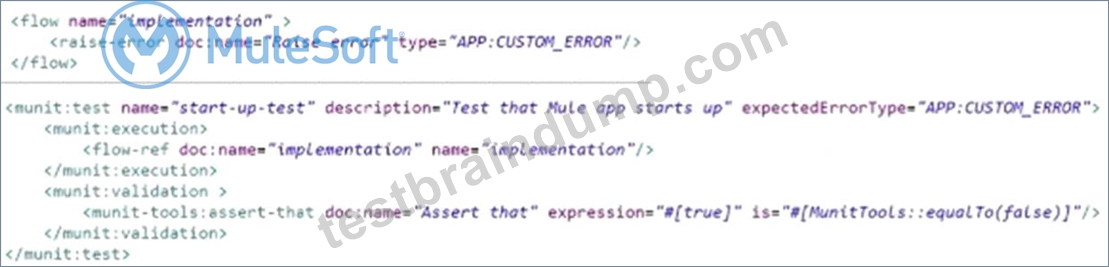
The flow name is ''implementation'' with code for the MUnit test case.
When the MUnit test case is executed, what is the expected result?
- A. The test case fails with an unexpected error type
- B. The test case fails with an assertion error
- C. The test throws an error and does not start
- D. The test case passes
Answer: B
Explanation:
Based on the code snippet and MUnit test case below, when the MUnit test case is executed, the expected result is that the test case fails with an assertion error. This is because the assert-equals processor compares two values for equality, and fails if they are not equal. In this case, the expected value is 'Hello World', but the actual value returned by the implementation flow is 'Hello Mule'. Therefore, the assertion fails and an error is thrown. References:https://docs.mulesoft.com/munit/2.3/assert-equals-processor
NEW QUESTION # 16
A developer deploys an API to CloudHub and applies an OAuth policy on API Manager. During testing, the API response is slow, so the developer reconfigures the API so that the out-of-the-box HTTP Caching policy is applied first, and the OAuth API policy is applied second.
What will happen when an HTTP request is received?
- A. In case of a cache miss, both the OAuth and HTTP Caching policies are evaluated; then the API retrieves the data from the API implementation, and the policy does not store the data in Object Store
- B. In case of a cache hit, both the OAuth and HTTP Caching policies are evaluated; then the cached response is returned to the caller
- C. In case of a cache it, only the HTTP Caching policy is evaluating; then the cached response is returned to the caller
- D. In case of a cache miss, only the HTTP Caching policy is evaluated; then the API retrieves the data from the API implementation, and the policy stores the data to be cached in Object Store
Answer: C
Explanation:
When an HTTP request is received and the HTTP Caching policy is applied first, it checks if there is a cached response for that request in Object Store. If there is a cache hit, meaning that a valid cached response exists, then only the HTTP Caching policy is evaluated and the cached response is returned to the caller without invoking the OAuth policy or the API implementation. If there is a cache miss, meaning that no valid cached response exists, then both the HTTP Caching policy and the OAuth policy are evaluated before invoking the API implementation.
References:https://docs.mulesoft.com/api-manager/2.x/http-caching-policy#policy-ordering
NEW QUESTION # 17
A Mule application includes a subflow containing a Scatter.Gather scope. Within each log of the Scatter.Gatter. an HTTP connector calls a PUT endpoint to modify records in different upstream system. The subflow is called inside an Unit successful scope to retry if a transitory exception is raised.
A technical spike is being performed to increase reliability of the Mule application.
Which steps should be performed within the Mule flow above the ensure idempontent behavior?
- A. Remove the Put requests from the Scatter-Getter and perform them sequentially
- B. Ensure an error-handling flow performs corrective actions to roll back all changes if any leg of the Scatter-Gather fails
- C. Change the PUT requests inside the Scatter-Gather to POST requests
- D. None, the flow already exhibits idempotent behavior
Answer: B
Explanation:
To ensure idempotent behavior within a Mule flow that contains a subflow with a Scatter-Gather scope, the developer should ensure an error-handling flow performs corrective actions to roll back all changes if any leg of the Scatter-Gather fails. Idempotency means that multiple identical requests have the same effect as a single request. Therefore, if one of the HTTP requests inside the Scatter-Gather fails, the error-handling flow should undo any changes made by other successful requests to ensure consistency and avoid partial updates.
References:
https://docs.mulesoft.com/mule-runtime/4.3/scatter-gather-concepthttps://docs.mulesoft.com/mule-runtime/4.3/e
NEW QUESTION # 18
A new Mule project has been created in Anypoint Studio with the default settings.
Which file inside the Mule project must be modified before using Maven to successfully deploy the application?
- A. Config.yaml
- B. Pom.xml
- C. Mule.artificact.json
- D. Settings.xml
Answer: B
NEW QUESTION # 19
A developer has created the first version of an API designed for business partners to work commodity prices.
What should developer do to allow more than one major version of the same API to be exposed by the implementation?
- A. In Design Center, open the RAML and modify baseUn to include a variable that indicates the version number
- B. In Anypoint Studio, generate scaffolding from the RAML, and the modify the <http:listerner> in the generated flows to include a parameter to replace the version number
- C. In Anypoint Studio, generate scaffolding from the RAML, and then modify the flow names generated by APIKit to include a variable with the major version number
- D. In Design Center, open the RAML and modify each operation to include the major version number
Answer: A
Explanation:
To allow more than one major version of the same API to be exposed by the implementation, the developer should modify the baseUri property in the RAML file to include a variable that indicates the version number.
The baseUri property defines the base URL of the API and can include variables that are replaced with actual values when mocking or deploying the API. By using a variable for the version number, the developer can expose different versions of the API using different base URLs and avoid conflicts or confusion. References:
https://docs.mulesoft.com/api-designer/design-modify-raml-specs#baseurihttps://docs.mulesoft.com/api-manager
NEW QUESTION # 20
An order processing system is composed of multiple Mule application responsible for warehouse, sales and shipping. Each application communication using Anypoint MQ. Each message must be correlated against the original order ID for observability and tracing.
How should a developer propagate the order ID as the correlation ID across each message?
- A. Wrap all Anypoint MQ Publish operations within a With CorrelationID scope from the Tracing module, setting the correlation ID to the order ID
- B. Set a custom Anypoint MQ user property to propagate the order ID and set the correlation ID in the receiving applications.
- C. Use the default correlation ID, Anypoint MQ will sutomatically propagate it.
- D. Use the underlying HTTP request of Anypoint MQ to set the 'X-CORRELATION_ID' header to the order ID
Answer: A
Explanation:
To propagate the order ID as the correlation ID across each message using Anypoint MQ, the developer should wrap all Anypoint MQ Publish operations within a With CorrelationID scope from the Tracing module, setting the correlation ID to the order ID. The With CorrelationID scope allows setting a custom correlation ID for any event that occurs within it. The Tracing module also enables distributed tracing across different Mule applications and services using Anypoint Monitoring. References:
https://docs.mulesoft.com/tracing-module/1.0/tracing-module-reference#with-correlation-id-scope
https://docs.mulesoft.com/tracing-module/1.0/tracing-module-concepts
NEW QUESTION # 21
A Mule application includes a subflow containing a Scatter.Gather scope. Within each log of the Scatter.Gatter. an HTTP connector calls a PUT endpoint to modify records in different upstream system. The subflow is called inside an Unit successful scope to retry if a transitory exception is raised.
A technical spike is being performed to increase reliability of the Mule application.
Which steps should be performed within the Mule flow above the ensure idempontent behavior?
- A. Remove the Put requests from the Scatter-Getter and perform them sequentially
- B. Ensure an error-handling flow performs corrective actions to roll back all changes if any leg of the Scatter-Gather fails
- C. Change the PUT requests inside the Scatter-Gather to POST requests
- D. None, the flow already exhibits idempotent behavior
Answer: B
Explanation:
Explanation
To ensure idempotent behavior within a Mule flow that contains a subflow with a Scatter-Gather scope, the developer should ensure an error-handling flow performs corrective actions to roll back all changes if any leg of the Scatter-Gather fails. Idempotency means that multiple identical requests have the same effect as a single request. Therefore, if one of the HTTP requests inside the Scatter-Gather fails, the error-handling flow should undo any changes made by other successful requests to ensure consistency and avoid partial updates.
References: https://docs.mulesoft.com/mule-runtime/4.3/scatter-gather-concept
https://docs.mulesoft.com/mule-runtime/4.3/error-handling
NEW QUESTION # 22
When registering a client application with an existing API instance or API Group instance, what is required to manually approve or reject request access?
- A. To only have Exchange Administrator permission
- B. To configure the SLA tier for the application
- C. To configure the SLA tier for the application and have the role of Organization Administrator, API Manager Environment Administrator, or the Manage Contacts permission
- D. To configure the SLA tier for the application and have the Exchange Administrator permission
Answer: A
Explanation:
To manually approve or reject request access when registering a client application with an existing API instance or API Group instance, it is required to configure the SLA tier for the application and have one of the following roles or permissions: Organization Administrator, API Manager Environment Administrator, or Manage Contracts permission. These roles or permissions allow managing client applications and contracts in API Manager.
References:https://docs.mulesoft.com/api-manager/2.x/client-applications#managing-client-applications-and-con
NEW QUESTION # 23
A Mule application deployed to a standardalone Mule runtime uses VM queues to publish messages to be consumed asynchronously by another flow.
In the case of a system failure, what will happen to in-flight messages in the VM queues that have been consumed?
- A. For any type of queue, the message will be lost
- B. For persistent queues, the message will be processed after the system comes online
- C. For transient queues, the message will be processed after the system comes online
- D. For nay type of queue, the message will be processed after the system comes online
Answer: B
Explanation:
In case of a system failure, in-flight messages in persistent VM queues that have been consumed will be processed after the system comes online. This is because persistent VM queues store messages on disk and guarantee delivery even if there is a system crash or restart. Therefore, any in-flight messages that have been consumed but not processed will be recovered from disk and processed when the system is back online.
References:https://docs.mulesoft.com/mule-runtime/4.3/vm-connector#persistent-queues
NEW QUESTION # 24
An API has been built to enable scheduling email provider. The front-end system does very little data entry validation, and problems have started to appear in the email that go to patients. A validate-customer'' flow is added validate the data.
What is he expected behavior of the 'validate-customer'' flow?
- A. If all of the values are invalid the last validation error is raised:SCHEDULE:INVALID_CUSTOMER_NAME
- B. If the appointment date and customer name are invalid, a
SCHEDULE:INVALID_APPOINTMENT_DATE error is raised - C. If the email address is invalid, processing continues to see if the appointment data and customer name are also invalid
- D. If only the email address Is invalid a VALIDATION.INVALID_EMAIL error is raised
Answer: D
Explanation:
The validate-customer flow uses an until-successful scope to validate each field of the customer data. The until-successful scope executes its processors until they succeed or exhausts the maximum number of retries.
If any processor fails, it raises an error and stops executing the remaining processors. Therefore, if only the email address is invalid, a VALIDATION.INVALID_EMAIL error is raised and the validation of appointment date and customer name is skipped.
References:https://docs.mulesoft.com/mule-runtime/4.3/until-successful-scope
NEW QUESTION # 25
A company has been using CI/CD. Its developers use Maven to handle build and deployment activities.
What is the correct sequence of activities that takes place during the Maven build and deployment?
- A. Validation, initialize, compile, test, package, install verify, deploy
- B. Initialize, validate, compute, test, package, verify, install, deploy
- C. Validate, initialize, compile, test package, verify, install, deploy
- D. Validate, initialize, compile, package, test, install, verify, verify, deploy
Answer: C
Explanation:
The correct sequence of activities that takes place during the Maven build and deployment is validate, initialize, compile, test package, verify, install, deploy. These are Maven lifecycle phases that define a sequence of goals to execute during a build process. Each phase represents a stage in the build lifecycle and can have zero or more goals bound to it.
References:https://maven.apache.org/guides/introduction/introduction-to-the-lifecycle.html
NEW QUESTION # 26
When a client and server are exchanging messages during the mTLS handshake, what is being agreed on during the cipher suite exchange?
- A. An encryption algorithm
- B. A protocol
- C. The TLS version
- D. The Public key format
Answer: A
Explanation:
A cipher suite is a set of cryptographic algorithms that are used to secure the communication between a client and a server. A cipher suite consists of four components: a key exchange algorithm, an authentication algorithm, an encryption algorithm, and a message authentication code (MAC) algorithm. During the cipher suite exchange, the client and the server agree on which encryption algorithm to use for encrypting and decrypting the data. References:https://docs.mulesoft.com/mule-runtime/4.3/tls-configuration#cipher-suites
NEW QUESTION # 27
Refer to the exhibit.
What is the result of the Mule Maven Plugin configuration of the value of property its,keystorePassoword in CloudHub 2.0?
- A. Anypoint Studio secures the value
- B. CloudHub encrypts the value
- C. Runtime Manager masks the value
- D. The Mule server encrypts the value
Answer: C
Explanation:
The result of the Mule Maven Plugin configuration of the value of property its,keystorePassword in CloudHub
2.0 is that Runtime Manager masks the value. This means that Runtime Manager hides or obscures the value from anyone who views it in Runtime Manager or Anypoint Platform.
References:https://docs.mulesoft.com/runtime-manager/runtime-manager-agent-for-mule4#properties-tab
NEW QUESTION # 28
Multiple individual Mute application need to use the Mule Maven plugin to deploy to CloudHub.
The plugin configuration should .. reused where necessary and anything project, specific should be property-based.
Where should the Mule Maven details be configured?
- A. A parent pom.xml
- B. Pom, xml
- C. A Bill of Materials (BOM) parent pm
- D. Settings, xml
Answer: A
Explanation:
Explanation
To reuse Mule Maven plugin configuration across multiple individual Mule applications, the developer should use a parent pom.xml file. A parent pom.xml file defines common configuration for one or more child projects that inherit from it. The developer can specify common properties and dependencies for all child projects in the parent pom.xml file, such as Mule Maven plugin configuration, and then reference them in each child project's pom.xml file using placeholders. References:
https://docs.mulesoft.com/mule-runtime/4.3/mmp-concept#parent-pom
https://maven.apache.org/guides/introduction/introduction-to-the-pom.html#Project_Inheritance
NEW QUESTION # 29
A company deploys 10 public APIs to CloudHub. Each API has its individual health endpoint defined. The platform operation team wants to configure API Functional Monitoring to monitor the health of the APIs periodically while minimizing operational overhead and cost.
How should API Functional Monitoring be configured?
- A. From one private location with all 10 APIs in a single schedule
- B. From one public location with each API in its own schedule
- C. From 10 public locations with each API in its own schedule
- D. From one public location with all 10 APIs in a single schedule
Answer: D
Explanation:
Explanation
To configure API Functional Monitoring to monitor the health of 10 public APIs periodically while minimizing operational overhead and cost, the developer should use one public location with all 10 APIs in a single schedule. A public location is a worker that runs in a CloudHub shared environment, which is cheaper and easier to maintain than a private location. A single schedule allows running all 10 APIs tests at the same time and frequency, which reduces complexity and resource consumption. References:
https://docs.mulesoft.com/functional-monitoring/fm-create-monitor#create-a-monitor
NEW QUESTION # 30
Refer to the exhibit.
When creating a new project, which API implementation allows for selecting the correct API version and scaffolding the flows from the API specification?
- A. Download RAML from Design Center
- B. Import RAML from local file
- C. Import a published API
- D. Generate a local RAML from anypoint Studio
Answer: A
Explanation:
To create a new project that selects the correct API version and scaffolds the flows from the API specification, the developer should import a published API. This option allows importing an API specification that has been published to Anypoint Exchange or Design Center, and selecting a specific version of that API specification.
The developer can also choose to scaffold flows based on that API specification.
References:https://docs.mulesoft.com/apikit/4.x/apikit-4-new-project-task
NEW QUESTION # 31
What is the MuleSoft recommended method to encrypt sensitive property data?
- A. The encryption key and sensitive data should be different for each environment
- B. The encryption key should be identical for all environments and the sensitive data should be different for each environment
- C. The encryption key should be identical for all environments
- D. The encryption key should be different for each environment and the sensitive data should be the same for all environments
Answer: A
NEW QUESTION # 32
......
Pass MuleSoft MCD-Level-2 Test Practice Test Questions Exam Dumps: https://quiztorrent.testbraindump.com/MCD-Level-2-exam-prep.html
