
Get Special Discount Offer of DP-300 Certification Exam Sample Questions and Answers
New DP-300 Dumps For Preparing Microsoft Azure Certified Microsoft Exam Well
NEW QUESTION # 49
You have an Azure SQL database named DB1 that contains a table named Orders. The Orders table contains a row for each sales order. Each sales order includes the name of the user who placed the order.
You need to implement row-level security (RLS). The solution must ensure that the users can view only their respective sales orders.
What should you include in the solution? To answer, select the appropriate options in the answer area.
NOTE: Each correct selection is worth one point.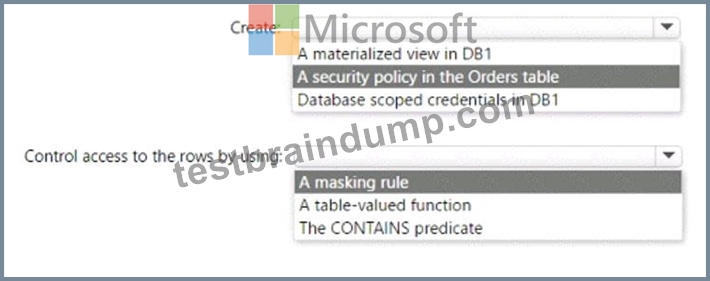
Answer:
Explanation:
Explanation
NEW QUESTION # 50
You have an Azure SQL database named DB 1 in the General Purpose service tier.
You need to monitor DB 1 by using SQL Insights.
What should you include in the solution? To answer, select the appropriate options in the answer area.
NOTE: Each correct selection is worth one point.
Answer:
Explanation:
Explanation
Box 1 = Azure Monitor Agent
Box 2 = An Azure SQL database
https://docs.microsoft.com/en-us/azure/azure-sql/database/sql-database-paas-overview?view=azuresql
NEW QUESTION # 51
Note: This question is part of a series of questions that present the same scenario. Each question in the series contains a unique solution that might meet the stated goals. Some question sets might have more than one correct solution, while others might not have a correct solution.
After you answer a question in this section, you will NOT be able to return to it. As a result, these questions will not appear in the review screen.
You have an Azure Data Lake Storage account that contains a staging zone.
You need to design a daily process to ingest incremental data from the staging zone, transform the data by executing an R script, and then insert the transformed data into a data warehouse in Azure Synapse Analytics.
Solution: You use an Azure Data Factory schedule trigger to execute a pipeline that copies the data to a staging table in the data warehouse, and then uses a stored procedure to execute the R script.
Does this meet the goal?
- A. Yes
- B. No
Answer: A
Explanation:
Section: [none]
Explanation:
If you need to transform data in a way that is not supported by Data Factory, you can create a custom activity with your own data processing logic and use the activity in the pipeline. You can create a custom activity to run R scripts on your HDInsight cluster with R installed.
Reference:
https://docs.microsoft.com/en-US/azure/data-factory/transform-data
Testlet 1
This is a case study. Case studies are not timed separately. You can use as much exam time as you would like to complete each case. However, there may be additional case studies and sections on this exam.
You must manage your time to ensure that you are able to complete all questions included on this exam in the time provided.
To answer the questions included in a case study, you will need to reference information that is provided in the case study. Case studies might contain exhibits and other resources that provide more information about the scenario that is described in the case study. Each question is independent of the other questions in this case study.
At the end of this case study, a review screen will appear. This screen allows you to review your answers and to make changes before you move to the next section of the exam. After you begin a new section, you cannot return to this section.
To start the case study
To display the first question in this case study, click the Next button. Use the buttons in the left pane to explore the content of the case study before you answer the questions. Clicking these buttons displays information such as business requirements, existing environment, and problem statements. If the case study has an All Information tab, note that the information displayed is identical to the information displayed on the subsequent tabs. When you are ready to answer a question, click the Question button to return to the question.
Overview
Litware, Inc. is a renewable energy company that has a main office in Boston. The main office hosts a sales department and the primary datacenter for the company.
Physical Locations
Litware has a manufacturing office and a research office is separate locations near Boston. Each office has its own datacenter and internet connection.
Existing Environment
Network Environment
The manufacturing and research datacenters connect to the primary datacenter by using a VPN.
The primary datacenter has an ExpressRoute connection that uses both Microsoft peering and private peering.
The private peering connects to an Azure virtual network named HubVNet.
Identity Environment
Litware has a hybrid Azure Active Directory (Azure AD) deployment that uses a domain named litwareinc.com.
All Azure subscriptions are associated to the litwareinc.com Azure AD tenant.
Database Environment
The sales department has the following database workload:
* An on-premises named SERVER1 hosts an instance of Microsoft SQL Server 2012 and two 1-TB databases.
* A logical server named SalesSrv01A contains a geo-replicated Azure SQL database named SalesSQLDb1.
SalesSQLDb1 is in an elastic pool named SalesSQLDb1Pool. SalesSQLDb1 uses database firewall rules and contained database users.
* An application named SalesSQLDb1App1 uses SalesSQLDb1.
The manufacturing office contains two on-premises SQL Server 2016 servers named SERVER2 and SERVER3. The servers are nodes in the same Always On availability group. The availability group contains a database named ManufacturingSQLDb1 Database administrators have two Azure virtual machines in HubVnet named VM1 and VM2 that run Windows Server 2019 and are used to manage all the Azure databases.
Licensing Agreement
Litware is a Microsoft Volume Licensing customer that has License Mobility through Software Assurance.
Current Problems
SalesSQLDb1 experiences performance issues that are likely due to out-of-date statistics and frequent blocking queries.
Requirements
Planned Changes
Litware plans to implement the following changes:
* Implement 30 new databases in Azure, which will be used by time-sensitive manufacturing apps that have varying usage patterns. Each database will be approximately 20 GB.
* Create a new Azure SQL database named ResearchDB1 on a logical server named ResearchSrv01.
ResearchDB1 will contain Personally Identifiable Information (PII) data.
* Develop an app named ResearchApp1 that will be used by the research department to populate and access ResearchDB1.
* Migrate ManufacturingSQLDb1 to the Azure virtual machine platform.
* Migrate the SERVER1 databases to the Azure SQL Database platform.
Technical Requirements
Litware identifies the following technical requirements:
* Maintenance tasks must be automated.
* The 30 new databases must scale automatically.
* The use of an on-premises infrastructure must be minimized.
* Azure Hybrid Use Benefits must be leveraged for Azure SQL Database deployments.
* All SQL Server and Azure SQL Database metrics related to CPU and storage usage and limits must be analyzed by using Azure built-in functionality.
Security and Compliance Requirements
Litware identifies the following security and compliance requirements:
* Store encryption keys in Azure Key Vault.
* Retain backups of the PII data for two months.
* Encrypt the PII data at rest, in transit, and in use.
* Use the principle of least privilege whenever possible.
* Authenticate database users by using Active Directory credentials.
* Protect Azure SQL Database instances by using database-level firewall rules.
* Ensure that all databases hosted in Azure are accessible from VM1 and VM2 without relying on public endpoints.
Business Requirements
Litware identifies the following business requirements:
* Meet an SLA of 99.99% availability for all Azure deployments.
* Minimize downtime during the migration of the SERVER1 databases.
* Use the Azure Hybrid Use Benefits when migrating workloads to Azure.
* Once all requirements are met, minimize costs whenever possible.
NEW QUESTION # 52
You have an Azure SQL database that contains a table named Employees. Employees contains a column named Salary.
You need to encrypt the Salary column. The solution must prevent database administrators from reading the data in the Salary column and must provide the most secure encryption.
Which three actions should you perform in sequence? To answer, move the appropriate actions from the list of actions to the answer area and arrange them in the correct order.
Answer:
Explanation:
Explanation:
Step 1: Create a column master key
Create a column master key metadata entry before you create a column encryption key metadata entry in the database and before any column in the database can be encrypted using Always Encrypted.
Step 2: Create a column encryption key.
Step 3: Encrypt the Salary column by using the randomized encryption type.
Randomized encryption uses a method that encrypts data in a less predictable manner. Randomized encryption is more secure, but prevents searching, grouping, indexing, and joining on encrypted columns.
Note: A column encryption key metadata object contains one or two encrypted values of a column encryption key that is used to encrypt data in a column. Each value is encrypted using a column master key.
Incorrect Answers:
Deterministic encryption.
Deterministic encryption always generates the same encrypted value for any given plain text value. Using deterministic encryption allows point lookups, equality joins, grouping and indexing on encrypted columns. However, it may also allow unauthorized users to guess information about encrypted values by examining patterns in the encrypted column, especially if there's a small set of possible encrypted values, such as True/False, or North/South/East/West region.
Reference:
https://docs.microsoft.com/en-us/sql/relational-databases/security/encryption/always-encrypted-database-engine
NEW QUESTION # 53
You create a new Azure SQL managed instance named SQL1 and enable Database Mail extended stored You need to ensure that SQ Server Agent jobs running on SQL 1 can notify when a failure Occurs Which three actions should you perform in sequence 7 TO answer. move the appropriate actions from the list Of actions to answer area and arrange them in correct order.
Answer:
Explanation:
1 - Create a Database Mail account.
2 - Create a profile named ,,,,,
3 - Enable email notifications upon failure.
NEW QUESTION # 54
You create a new Azure SQL managed instance named SQL1 and enable Database Mail extended stored procedures.
You need to ensure that SOL Server Agent jobs running on SQL 1 can notify administrators when a failure occurs.
Which three actions should you perform in sequence? To answer, move the appropriate actions from the list of actions to the answer area and arrange them in the correct order.
Answer:
Explanation:
Explanation
NEW QUESTION # 55
You have an Azure subscription that contains an Azure SQL database.
The database fails to respond to queries in a timely manner.
You need to identify whether the issue relates to resource_semaphore waits.
How should you complete the Transact-SQL query? To answer, select the appropriate options in the answer area.
NOTE: Each correct selection is worth one point.
Answer:
Explanation:
Reference:
https://docs.microsoft.com/en-us/azure/azure-sql/database/monitoring-with-dmvs
NEW QUESTION # 56
You have an Azure SQL database.
You are reviewing a slow performing query as shown in the following exhibit.
Use the drop-down menus to select the answer choice that completes each statement based on the information presented in the graphic.
NOTE: Each correct selection is worth one point.
Answer:
Explanation:
Explanation
Graphical user interface, text, application, email Description automatically generated
Reference:
https://docs.microsoft.com/en-us/sql/relational-databases/performance/live-query-statistics?view=sql-server-ver1
NEW QUESTION # 57
You have an Azure subscription.
You need to deploy an Azure SQL managed instance by using an Azure Resource Manager (ARM) template.
The solution must meet the following requirements:
The SQL managed instance must be assigned a unique identity.
The SQL managed instance must be available in the event of an Azure datacenter outage.
How should you complete the template? To answer, drag the appropriate values to the correct targets. Each value may be used once, more than once, or not at all. You may need to drag the split bar between panes or scroll to view content.
NOTE: Each correct selection is worth one point.
Answer:
Explanation:
Explanation
NEW QUESTION # 58
You have SQL Server 2019 on an Azure virtual machine that runs Windows Server 2019. The virtual machine has 4 vCPUs and 28 GB of memory.
You scale up the virtual machine to 8 vCPUSs and 64 GB of memory.
You need to provide the lowest latency for tempdb.
What is the total number of data files that tempdb should contain?
- A. 0
- B. 1
- C. 2
- D. 3
Answer: D
Explanation:
Explanation
The number of files depends on the number of (logical) processors on the machine. As a general rule, if the number of logical processors is less than or equal to eight, use the same number of data files as logical processors. If the number of logical processors is greater than eight, use eight data files and then if contention continues, increase the number of data files by multiples of 4 until the contention is reduced to acceptable levels or make changes to the workload/code.
Reference:
https://docs.microsoft.com/en-us/sql/relational-databases/databases/tempdb-database
NEW QUESTION # 59
HOTSPOT
You have an Azure SQL database named db1.
You need to retrieve the resource usage of db1 from the last week.
How should you complete the statement? To answer, select the appropriate options in the answer area.
NOTE: Each correct selection is worth one point.
Hot Area:
Answer:
Explanation:
Section: [none]
Explanation:
Box 1: sys.resource_stats
sys.resource_stats returns CPU usage and storage data for an Azure SQL Database. It has database_name and start_time columns.
Box 2: DateAdd
The following example returns all databases that are averaging at least 80% of compute utilization over the last one week.
DECLARE @s datetime;
DECLARE @e datetime;
SET @s= DateAdd(d,-7,GetUTCDate());
SET @e= GETUTCDATE();
SELECT database_name, AVG(avg_cpu_percent) AS Average_Compute_Utilization FROM sys.resource_stats WHERE start_time BETWEEN @s AND @e GROUP BY database_name HAVING AVG(avg_cpu_percent) >= 80 Incorrect Answers:
sys.dm_exec_requests:
sys.dm_exec_requests returns information about each request that is executing in SQL Server. It does not have a column named database_name.
sys.dm_db_resource_stats:
sys.dm_db_resource_stats does not have any start_time column.
Note: sys.dm_db_resource_stats returns CPU, I/O, and memory consumption for an Azure SQL Database database. One row exists for every 15 seconds, even if there is no activity in the database. Historical data is maintained for approximately one hour.
Sys.dm_user_db_resource_governance returns actual configuration and capacity settings used by resource governance mechanisms in the current database or elastic pool. It does not have any start_time column.
Reference:
https://docs.microsoft.com/en-us/sql/relational-databases/system-catalog-views/sys-resource-stats-azure-sql- database
NEW QUESTION # 60
You have an Azure SQL database.
You run the following PowerShell script.
For each of the following statements, select Yes if the statement is true. Otherwise, select No.
NOTE: Each correct selection is worth one point.
Answer:
Explanation:
Explanation
Text Description automatically generated
Reference:
https://docs.microsoft.com/en-us/powershell/module/az.sql/set-azsqldatabasebackupshorttermretentionpolicy?vie
https://docs.microsoft.com/en-us/powershell/module/az.sql/set-azsqldatabasebackuplongtermretentionpolicy?vie
NEW QUESTION # 61
You have an Azure SQL database.
You are reviewing a slow performing query as shown in the following exhibit.
Use the drop-down menus to select the answer choice that completes each statement based on the information presented in the graphic.
NOTE: Each correct selection is worth one point.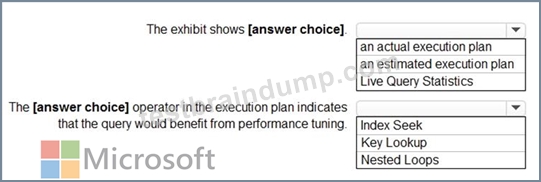
Answer:
Explanation:
Reference:
https://docs.microsoft.com/en-us/sql/relational-databases/performance/live-query-statistics?view=sql-server-ver15
NEW QUESTION # 62
You have two instances of SQL Server on Azure virtual Machines named VM1 and VM2. VM1 hosts a database named dbl.
You plan to create a database availability group (DAG) for dbl. The solution must use certificate authentication between VM1 and VM2.
You need to configure authentication for the outbound connections of VM1.
Which three actions should you perform in sequence? To answer, move the appropriate actions from the list of actions to the answer area and arrange them in the correct order.
Answer:
Explanation:
1 - From the master database, run CREATE MASTER KEY...
2 - From the master databse, run CREATE CERTIFICATE.
3 - From db1, run CREATE ENDPOINT.
NEW QUESTION # 63
You have an Azure subscription that uses a domain named contoso.com.
You have two Azure VMs named DBServer1 and DBServer2. Each of them hosts a default SQL Server instance. DBServer1 is in the East US Azure region and contains a database named DatabaseA. DBServer2 is in the West US Azure region.
DBServer1 has a high volume of data changes and low latency requirements for data writes.
You need to configure a new availability group for DatabaseA. The secondary replica will reside on DBServer2.
What should you do?
- A. Configure the primary endpoint as TCP://DBServer1.contoso.com:445, configure the secondary endpoint as TCP://DBServer2.contoso.com:445, and set the availability mode to Asynchronous.
- B. Configure the primary endpoint as TCP://DBServer1.contoso.com:5022, configure the secondary endpoint as TCP://DBServer2.contoso.com:5022, and set the availability mode to Asynchronous.
- C. Configure the primary endpoint as TCP://DBServer1.contoso.com:5022, configure the secondary endpoint as TCP://DBServer2.contoso.com:5022, and set the availability mode to Synchronous.
- D. Configure the primary endpoint as TCP://DBServer1.contoso.com:445, configure the secondary endpoint as TCP://DBServer2.contoso.com:445, and set the availability mode to Synchronous.
Answer: B
Explanation:
Reference:
https://docs.microsoft.com/en-us/sql/database-engine/availability-groups/windows/availability-modes-always-on
NEW QUESTION # 64
You need to trigger an Azure Data Factory pipeline when a file arrives in an Azure Data Lake Storage Gen2 container.
Which resource provider should you enable?
- A. Microsoft.EventGrid
- B. Microsoft.Automation
- C. Microsoft.Sql
- D. Microsoft.EventHub
Answer: A
Explanation:
Event-driven architecture (EDA) is a common data integration pattern that involves production, detection, consumption, and reaction to events. Data integration scenarios often require Data Factory customers to trigger
pipelines based on events happening in storage account, such as the arrival or deletion of a file in Azure Blob Storage account. Data Factory natively integrates with Azure Event Grid, which lets you trigger pipelines on such events.
Reference:
https://docs.microsoft.com/en-us/azure/data-factory/how-to-create-event-trigger
NEW QUESTION # 65
......
Updated DP-300 Dumps Questions Are Available For Passing Microsoft Exam: https://quiztorrent.testbraindump.com/DP-300-exam-prep.html
