
2022 Updated Verified DP-203 dumps Q&As - 100% Pass Guaranteed
Provide Valid Dumps To Help You Prepare For Data Engineering on Microsoft Azure Exam
Certification Topics of Microsoft DP-203 Exam
Design and implement data security (10-15%)
Monitor and optimize data storage and data processing (10-15%)
Design and develop data processing (25-30%)
Design and implement data storage (40-45%)
NEW QUESTION 62
You have an Azure Data Lake Storage Gen2 account that contains a JSON file for customers. The file contains two attributes named FirstName and LastName.
You need to copy the data from the JSON file to an Azure Synapse Analytics table by using Azure Databricks. A new column must be created that concatenates the FirstName and LastName values.
You create the following components:
A destination table in Azure Synapse
An Azure Blob storage container
A service principal
In which order should you perform the actions? To answer, move the appropriate actions from the list of actions to the answer area and arrange them in the correct order.
Answer:
Explanation:
Reference:
https://docs.microsoft.com/en-us/azure/azure-databricks/databricks-extract-load-sql-data-warehouse
NEW QUESTION 63
You use Azure Data Factory to prepare data to be queried by Azure Synapse Analytics serverless SQL pools.
Files are initially ingested into an Azure Data Lake Storage Gen2 account as 10 small JSON files. Each file contains the same data attributes and data from a subsidiary of your company.
You need to move the files to a different folder and transform the data to meet the following requirements:
Provide the fastest possible query times.
Automatically infer the schema from the underlying files.
How should you configure the Data Factory copy activity? To answer, select the appropriate options in the answer area.
NOTE: Each correct selection is worth one point.
Answer:
Explanation:
Reference:
https://docs.microsoft.com/en-us/azure/storage/blobs/data-lake-storage-introduction
https://docs.microsoft.com/en-us/azure/data-factory/format-parquet
NEW QUESTION 64
You are designing a monitoring solution for a fleet of 500 vehicles. Each vehicle has a GPS tracking device that sends data to an Azure event hub once per minute.
You have a CSV file in an Azure Data Lake Storage Gen2 container. The file maintains the expected geographical area in which each vehicle should be.
You need to ensure that when a GPS position is outside the expected area, a message is added to another event hub for processing within 30 seconds. The solution must minimize cost.
What should you include in the solution? To answer, select the appropriate options in the answer area.
NOTE: Each correct selection is worth one point.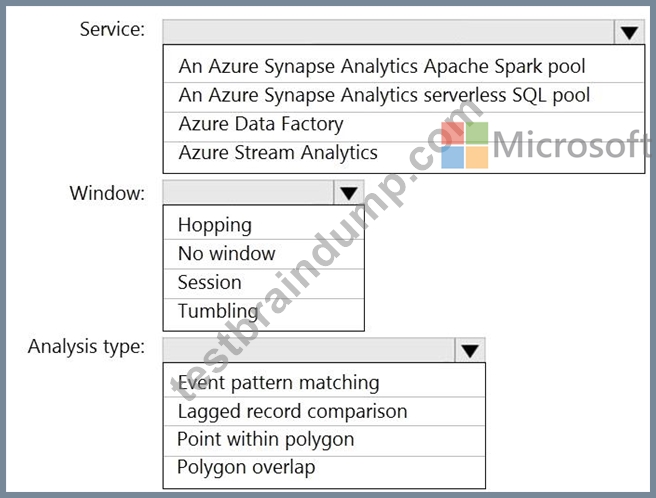
Answer:
Explanation:
Reference:
https://docs.microsoft.com/en-us/azure/stream-analytics/stream-analytics-window-functions
NEW QUESTION 65
You have a self-hosted integration runtime in Azure Data Factory.
The current status of the integration runtime has the following configurations:
Status: Running
Type: Self-Hosted
Running / Registered Node(s): 1/1
High Availability Enabled: False
Linked Count: 0
Queue Length: 0
Average Queue Duration. 0.00s
The integration runtime has the following node details:
Name: X-M
Status: Running
Available Memory: 7697MB
CPU Utilization: 6%
Network (In/Out): 1.21KBps/0.83KBps
Concurrent Jobs (Running/Limit): 2/14
Role: Dispatcher/Worker
Credential Status: In Sync
Use the drop-down menus to select the answer choice that completes each statement based on the information presented.
NOTE: Each correct selection is worth one point.
Answer:
Explanation:
Reference:
https://docs.microsoft.com/en-us/azure/data-factory/create-self-hosted-integration-runtime
NEW QUESTION 66
You are designing an Azure Stream Analytics job to process incoming events from sensors in retail environments.
You need to process the events to produce a running average of shopper counts during the previous 15 minutes, calculated at five-minute intervals.
Which type of window should you use?
- A. snapshot
- B. hopping
- C. tumbling
- D. sliding
Answer: C
Explanation:
Explanation
Tumbling windows are a series of fixed-sized, non-overlapping and contiguous time intervals. The following diagram illustrates a stream with a series of events and how they are mapped into 10-second tumbling windows.
Reference:
https://docs.microsoft.com/en-us/stream-analytics-query/tumbling-window-azure-stream-analytics
NEW QUESTION 67
You plan to create an Azure Synapse Analytics dedicated SQL pool.
You need to minimize the time it takes to identify queries that return confidential information as defined by the company's data privacy regulations and the users who executed the queues.
Which two components should you include in the solution? Each correct answer presents part of the solution.
NOTE: Each correct selection is worth one point.
- A. dynamic data masking for columns that contain confidential information
- B. audit logs sent to a Log Analytics workspace
- C. sensitivity-classification labels applied to columns that contain confidential information
- D. resource tags for databases that contain confidential information
Answer: B,C
Explanation:
Explanation
A: You can classify columns manually, as an alternative or in addition to the recommendation-based classification:
* Select Add classification in the top menu of the pane.
* In the context window that opens, select the schema, table, and column that you want to classify, and the information type and sensitivity label.
* Select Add classification at the bottom of the context window.
C: An important aspect of the information-protection paradigm is the ability to monitor access to sensitive data. Azure SQL Auditing has been enhanced to include a new field in the audit log called data_sensitivity_information. This field logs the sensitivity classifications (labels) of the data that was returned by a query. Here's an example:
Reference:
https://docs.microsoft.com/en-us/azure/azure-sql/database/data-discovery-and-classification-overview
NEW QUESTION 68
You have a SQL pool in Azure Synapse.
A user reports that queries against the pool take longer than expected to complete.
You need to add monitoring to the underlying storage to help diagnose the issue.
Which two metrics should you monitor? Each correct answer presents part of the solution.
NOTE: Each correct selection is worth one point.
- A. Cache used percentage
- B. Cache hit percentage
- C. DWU Limit
- D. Snapshot Storage Size
- E. Active queries
Answer: A,B
Explanation:
Explanation
A: Cache used is the sum of all bytes in the local SSD cache across all nodes and cache capacity is the sum of the storage capacity of the local SSD cache across all nodes.
E: Cache hits is the sum of all columnstore segments hits in the local SSD cache and cache miss is the columnstore segments misses in the local SSD cache summed across all nodes Reference:
https://docs.microsoft.com/en-us/azure/synapse-analytics/sql-data-warehouse/sql-data-warehouse-concept-resou
NEW QUESTION 69
You have an Azure subscription that contains an Azure Data Lake Storage account. The storage account contains a data lake named DataLake1.
You plan to use an Azure data factory to ingest data from a folder in DataLake1, transform the data, and land the data in another folder.
You need to ensure that the data factory can read and write data from any folder in the DataLake1 file system.
The solution must meet the following requirements:
* Minimize the risk of unauthorized user access.
* Use the principle of least privilege.
* Minimize maintenance effort.
How should you configure access to the storage account for the data factory? To answer, select the appropriate options in the answer area.
NOTE: Each correct selection is worth one point.
Answer:
Explanation:
Explanation
Text Description automatically generated with low confidence
Box 1: Azure Active Directory (Azure AD)
On Azure, managed identities eliminate the need for developers having to manage credentials by providing an identity for the Azure resource in Azure AD and using it to obtain Azure Active Directory (Azure AD) tokens.
Box 2: a managed identity
A data factory can be associated with a managed identity for Azure resources, which represents this specific data factory. You can directly use this managed identity for Data Lake Storage Gen2 authentication, similar to using your own service principal. It allows this designated factory to access and copy data to or from your Data Lake Storage Gen2.
Note: The Azure Data Lake Storage Gen2 connector supports the following authentication types.
* Account key authentication
* Service principal authentication
* Managed identities for Azure resources authentication
Reference:
https://docs.microsoft.com/en-us/azure/active-directory/managed-identities-azure-resources/overview
https://docs.microsoft.com/en-us/azure/data-factory/connector-azure-data-lake-storage
NEW QUESTION 70
You have an Azure Storage account that generates 200,000 new files daily. The file names have a format of {YYYY}/{MM}/{DD}/{HH}/{CustomerID}.csv.
You need to design an Azure Data Factory solution that will load new data from the storage account to an Azure Data Lake once hourly. The solution must minimize load times and costs.
How should you configure the solution? To answer, select the appropriate options in the answer are a.
NOTE: Each correct selection is worth one point.
Answer:
Explanation:
Reference:
https://docs.microsoft.com/en-us/stream-analytics-query/tumbling-window-azure-stream-analytics
NEW QUESTION 71
You have an Azure Synapse Analytics SQL pool named Pool1 on a logical Microsoft SQL server named Server1.
You need to implement Transparent Data Encryption (TDE) on Pool1 by using a custom key named key1.
Which five actions should you perform in sequence? To answer, move the appropriate actions from the list of actions to the answer area and arrange them in the correct order.
Answer:
Explanation:
Explanation
Graphical user interface, text, application Description automatically generated
Step 1: Assign a managed identity to Server1
You will need an existing Managed Instance as a prerequisite.
Step 2: Create an Azure key vault and grant the managed identity permissions to the vault Create Resource and setup Azure Key Vault.
Step 3: Add key1 to the Azure key vault
The recommended way is to import an existing key from a .pfx file or get an existing key from the vault.
Alternatively, generate a new key directly in Azure Key Vault.
Step 4: Configure key1 as the TDE protector for Server1
Provide TDE Protector key
Step 5: Enable TDE on Pool1
Reference:
https://docs.microsoft.com/en-us/azure/azure-sql/managed-instance/scripts/transparent-data-encryption-byok-pow
NEW QUESTION 72
You have the following table named Employees.
You need to calculate the employee _type value based on the hire date value.
How should you complete the Transact-SQL statement? To answer, drag the appropriate values to the correct targets. Each value may be used once, more than once, or not at all. You may need to drag the split bar between panes or scroll to view content- NOTE: Each correct selection is worth one point.
Answer:
Explanation:
NEW QUESTION 73
You plan to create an Azure Data Lake Storage Gen2 account
You need to recommend a storage solution that meets the following requirements:
* Provides the highest degree of data resiliency
* Ensures that content remains available for writes if a primary data center fails What should you include in the recommendation? To answer, select the appropriate options in the answer area.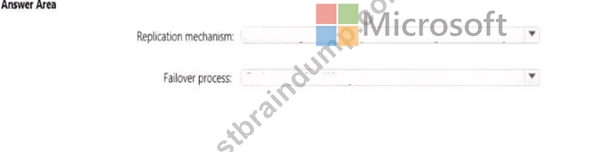
Answer:
Explanation:
See the answer in explanation.
Explanation
Answer is below
NEW QUESTION 74
You are designing a fact table named FactPurchase in an Azure Synapse Analytics dedicated SQL pool. The table contains purchases from suppliers for a retail store. FactPurchase will contain the following columns.
FactPurchase will have 1 million rows of data added daily and will contain three years of data.
Transact-SQL queries similar to the following query will be executed daily.
SELECT
SupplierKey, StockItemKey, COUNT(*)
FROM FactPurchase
WHERE DateKey >= 20210101
AND DateKey <= 20210131
GROUP By SupplierKey, StockItemKey
Which table distribution will minimize query times?
- A. replicated
- B. round-robin
- C. hash-distributed on DateKey
- D. hash-distributed on PurchaseKey
Answer: D
Explanation:
Explanation
Hash-distributed tables improve query performance on large fact tables, and are the focus of this article.
Round-robin tables are useful for improving loading speed.
Reference:
https://docs.microsoft.com/en-us/azure/synapse-analytics/sql-data-warehouse/sql-data-warehouse-tables-distribu
NEW QUESTION 75
You have an Azure Stream Analytics job that is a Stream Analytics project solution in Microsoft Visual Studio. The job accepts data generated by IoT devices in the JSON format.
You need to modify the job to accept data generated by the IoT devices in the Protobuf format.
Which three actions should you perform from Visual Studio on sequence? To answer, move the appropriate actions from the list of actions to the answer area and arrange them in the correct order.
Answer:
Explanation:
Explanation
Step 1: Add an Azure Stream Analytics Custom Deserializer Project (.NET) project to the solution.
Create a custom deserializer
1. Open Visual Studio and select File > New > Project. Search for Stream Analytics and select Azure Stream Analytics Custom Deserializer Project (.NET). Give the project a name, like Protobuf Deserializer.
2. In Solution Explorer, right-click your Protobuf Deserializer project and select Manage NuGet Packages from the menu. Then install the Microsoft.Azure.StreamAnalytics and Google.Protobuf NuGet packages.
3. Add the MessageBodyProto class and the MessageBodyDeserializer class to your project.
4. Build the Protobuf Deserializer project.
Step 2: Add .NET deserializer code for Protobuf to the custom deserializer project Azure Stream Analytics has built-in support for three data formats: JSON, CSV, and Avro. With custom .NET deserializers, you can read data from other formats such as Protocol Buffer, Bond and other user defined formats for both cloud and edge jobs.
Step 3: Add an Azure Stream Analytics Application project to the solution Add an Azure Stream Analytics project
* In Solution Explorer, right-click the Protobuf Deserializer solution and select Add > New Project. Under Azure Stream Analytics > Stream Analytics, choose Azure Stream Analytics Application. Name it ProtobufCloudDeserializer and select OK.
* Right-click References under the ProtobufCloudDeserializer Azure Stream Analytics project. Under Projects, add Protobuf Deserializer. It should be automatically populated for you.
Reference:
https://docs.microsoft.com/en-us/azure/stream-analytics/custom-deserializer
NEW QUESTION 76
You need to design a data ingestion and storage solution for the Twitter feeds. The solution must meet the customer sentiment analytics requirements.
What should you include in the solution To answer, select the appropriate options in the answer area NOTE Each correct selection b worth one point.
Answer:
Explanation:
NEW QUESTION 77
You are developing a solution using a Lambda architecture on Microsoft Azure.
The data at test layer must meet the following requirements:
Data storage:
*Serve as a repository (or high volumes of large files in various formats.
*Implement optimized storage for big data analytics workloads.
*Ensure that data can be organized using a hierarchical structure.
Batch processing:
*Use a managed solution for in-memory computation processing.
*Natively support Scala, Python, and R programming languages.
*Provide the ability to resize and terminate the cluster automatically.
Analytical data store:
*Support parallel processing.
*Use columnar storage.
*Support SQL-based languages.
You need to identify the correct technologies to build the Lambda architecture.
Which technologies should you use? To answer, select the appropriate options in the answer area NOTE: Each correct selection is worth one point.
Answer:
Explanation:
Explanation
Data storage: Azure Data Lake Store
A key mechanism that allows Azure Data Lake Storage Gen2 to provide file system performance at object storage scale and prices is the addition of a hierarchical namespace. This allows the collection of objects/files within an account to be organized into a hierarchy of directories and nested subdirectories in the same way that the file system on your computer is organized. With the hierarchical namespace enabled, a storage account becomes capable of providing the scalability and cost-effectiveness of object storage, with file system semantics that are familiar to analytics engines and frameworks.
Batch processing: HD Insight Spark
Aparch Spark is an open-source, parallel-processing framework that supports in-memory processing to boost the performance of big-data analysis applications.
HDInsight is a managed Hadoop service. Use it deploy and manage Hadoop clusters in Azure. For batch processing, you can use Spark, Hive, Hive LLAP, MapReduce.
Languages: R, Python, Java, Scala, SQL
Analytic data store: SQL Data Warehouse
SQL Data Warehouse is a cloud-based Enterprise Data Warehouse (EDW) that uses Massively Parallel Processing (MPP).
SQL Data Warehouse stores data into relational tables with columnar storage.
References:
https://docs.microsoft.com/en-us/azure/storage/blobs/data-lake-storage-namespace
https://docs.microsoft.com/en-us/azure/architecture/data-guide/technology-choices/batch-processing
https://docs.microsoft.com/en-us/azure/sql-data-warehouse/sql-data-warehouse-overview-what-is
NEW QUESTION 78
You need to implement an Azure Databricks cluster that automatically connects to Azure Data Lake Storage Gen2 by using Azure Active Directory (Azure AD) integration.
How should you configure the new cluster? To answer, select the appropriate options in the answer area.
NOTE: Each correct selection is worth one point.
Answer:
Explanation:
References:
https://docs.azuredatabricks.net/spark/latest/data-sources/azure/adls-passthrough.html
NEW QUESTION 79
Which Azure Data Factory components should you recommend using together to import the daily inventory data from the SQL server to Azure Data Lake Storage? To answer, select the appropriate options in the answer area.
NOTE: Each correct selection is worth one point.
Answer:
Explanation:
NEW QUESTION 80
You have an Azure Synapse Analytics serverless SQL pool named Pool1 and an Azure Data Lake Storage Gen2 account named storage1. The AllowedBlobpublicAccess porperty is disabled for storage1.
You need to create an external data source that can be used by Azure Active Directory (Azure AD) users to access storage1 from Pool1.
What should you create first?
- A. database scoped credentials
- B. an external library
- C. a remote service binding
- D. an external resource pool
Answer: A
NEW QUESTION 81
......
Data Engineering on Microsoft Azure Exam Certification Details:
| Sample Questions | Data Engineering on Microsoft Azure Sample Questions |
| Exam Code | DP-203 |
| Books / Training | DP-203T00: Data Engineering on Microsoft Azure |
| Exam Name | Microsoft Certified - Azure Data Engineer Associate |
| Number of Questions | 40-60 |
| Exam Price | $165 (USD) |
Achieve Success in Actual DP-203 Exam DP-203 Exam Dumps: https://quiztorrent.testbraindump.com/DP-203-exam-prep.html
