
Salesforce OmniStudio-Developer Real Exam Questions and Answers FREE
Exam Dumps OmniStudio-Developer Practice Free Latest Salesforce Practice Tests
Salesforce Certified OmniStudio Developer exam is designed to test the candidate's knowledge and skills in developing solutions using OmniStudio. OmniStudio-Developer exam covers various topics including OmniStudio development, data modeling, user interface design, integrations, security, and testing. OmniStudio-Developer exam has 60 multiple-choice questions and must be completed within 105 minutes. To pass the exam, the candidate must score at least 68%.
Salesforce OmniStudio is a powerful platform for developing custom applications that streamline business processes and enhance productivity. By earning the Salesforce OmniStudio Developer certification, professionals can demonstrate their expertise in using this platform to create innovative solutions that meet their clients' unique needs. With this certification, individuals can boost their career prospects and gain recognition as experts in the field of Salesforce development. So, if you are a Salesforce developer looking to enhance your skills and demonstrate your expertise in building custom applications using OmniStudio, this certification is definitely worth pursuing.
NEW QUESTION # 17
Refer to the exhibit below. What is the marge code needed for this integration procedure structure to pass a CaseNumber node from the DRReadCase DataRaptor Extract Action to the HTTP Action's HTTP URL?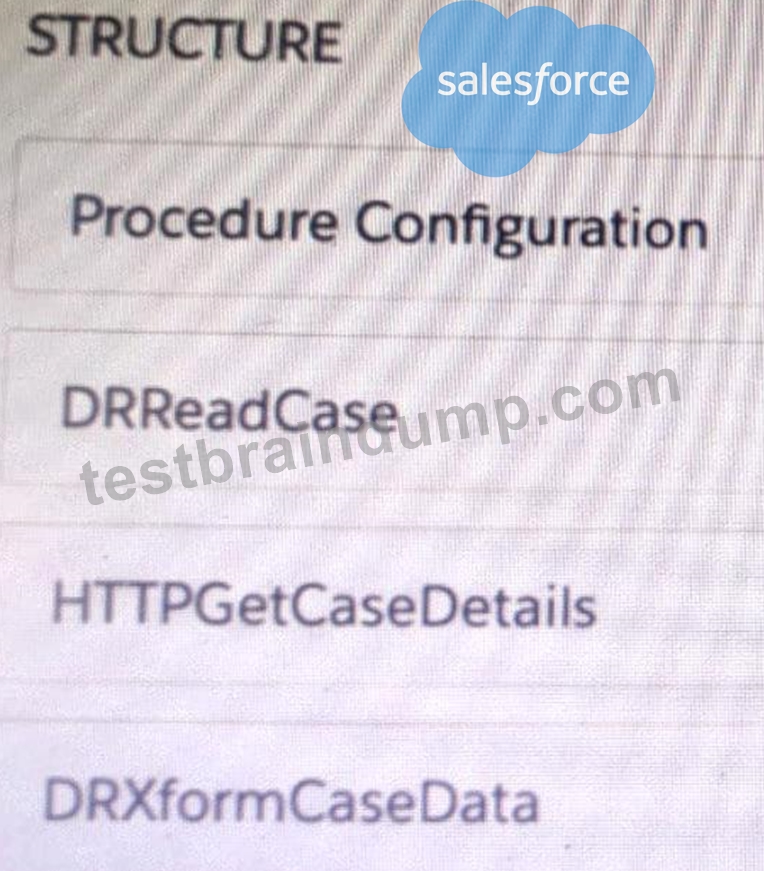
- A. %DRReadCase: CaseNumber%
- B. ((CaseNumber))
- C. ((DRRCase, CaseNumber))
- D. MTTOPDetCaseDetail: CaseNumber%
Answer: A
Explanation:
The merge code syntax for passing data from a DataRaptor Extract Action to an HTTP Action is % DataRaptorName: NodeName%. In this case, it is %DRReadCase: CaseNumber%.
NEW QUESTION # 18
An OmniScript updates data from one Salesforce record, but when it completes, only some of the data is updated in Salesforce. A Data Mapper Load saves the data. What error could cause this behavior?
Choose 2 answers
- A. In the Data Mapper Load, in the preview tab, the RecordId is from the wrong record type.
- B. ContextId is misspelled in the merge code that passes the RecordId to the Data Mapper.
- C. The fields that are not updated are read-only in Salesforce.
- D. The Input JSON paths in the Data Mapper Load do not match the JSON sent from the OmniScript.
Answer: C,D
Explanation:
According to the Salesforce OmniStudio DataRaptor documentation, specifically under DataRaptor Load Best Practices and Common Issues:
* A. "The Input JSON paths in the Data Mapper Load do not match the JSON sent from the OmniScript." This is a common configuration issue. If the paths between the OmniScript's structure and the DataRaptor Load mapping are mismatched, fields may not map correctly, resulting in partial updates or no updates.
* B. "The fields that are not updated are read-only in Salesforce."If a field is Read-Only at the field- level security (FLS) or object schema, DataRaptor Load will not be able to write to it, which explains why only some data is updated.
Incorrect Options:
* C. The RecordId from the wrong record type would typically cause a complete failure, not a partial update.
* D. A misspelled ContextId could prevent data from being linked correctly, but this is less likely to cause partial field-level issues, and more likely to affect record association.
:
Salesforce OmniStudio Developer Guide # DataRaptor Load # Troubleshooting Salesforce Help Documentation: OmniStudio DataRaptor Best Practices
NEW QUESTION # 19
...... configure Additional input to send exactly the same data? Assume that the develop checked Send Only Additional input.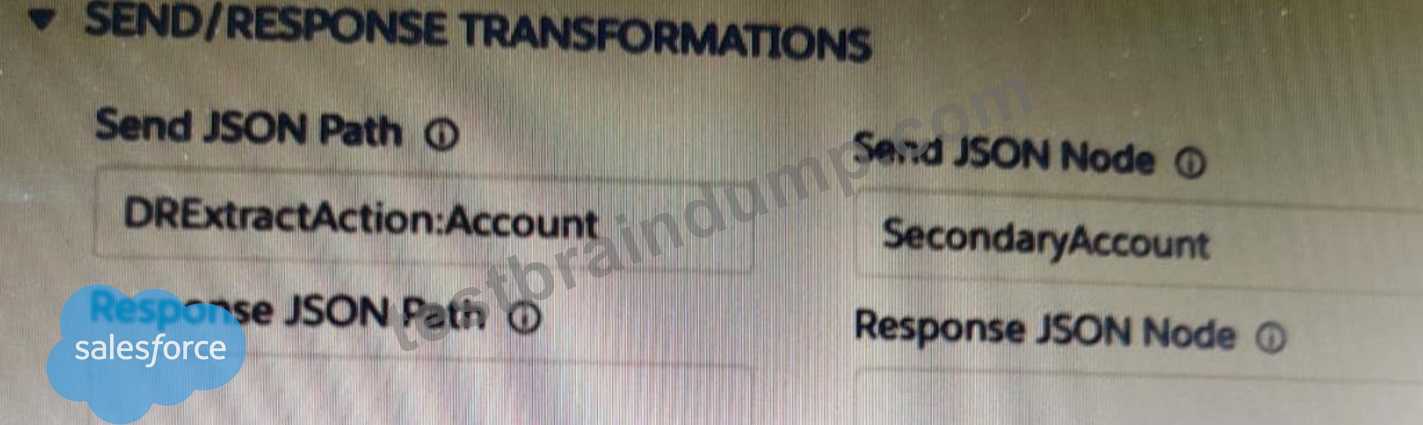
A)
B)
C)
D)
- A. Option A
- B. Option C
- C. Option D
- D. Option B
Answer: C
NEW QUESTION # 20
A developerneedsto use the CONTIF function to process data entered by the user in an OmniScript. The output of the function needs to be displayed to the user immediately in the current step.
Based on best practice, what element should the developer use this function in?
- A. A Range element
- B. A formula element
- C. A Calculation Action element
- D. A SetValues element
Answer: B
Explanation:
A formula element allows the developer to define formulas using functions and operators to manipulate data in an OmniScript. The output of the formula element can be displayed to the user immediately in the current step using a display element. The CONTIF function counts how many times a value appears in a list1. A Calculation Action element executes a calculation procedure and returns the output as a JSON object. A Set Values element assigns values to variables or fields in an OmniScript. A Range element defines a range of values for a variable or field in an OmniScript1. Based on best practice, a formula element is the most suitable element to use the CONTIF function in this scenario.
NEW QUESTION # 21
An integration procedure contains a Remote Action element that calls a method of an APEXclass. The method requires two fields are input: Accountid and ProductId. The integration Procedure data JSON contains the following nodes:
How should the Remote Action element be configured to pass the data correctly to the method?
- A. Set Return Only Additional Output to true, and add the following Key/Value pairs to additional input.
- B. Check the Send OnlyAdditional Input checkbox, and the following/ value pairs to Additional input:
- C. Check the DataRaptor Transform checkbox, and add the following Key/Value pairs to Output JSON Path:
- D. Add the following to Send JSON Path: accountId: %Accountd% ProductId% Details Products%
Answer: B
Explanation:
Checking the Send Only Additional Input checkbox allows the Remote Action element to send only the key/value pairs specified in Additional input to the Apex method. The Additional input should have the same keys as the method parameters, and the values should be set to {{InputData.node}} for each node. For example, AccountId: {{InputData.AccountId}} and ProductId: {{InputData.Details.Products}}.
NEW QUESTION # 22
A developer builds a new OmniScript. It contains aSet Values element with a ContextId key/value pair that was used during testing.
What should the developer do before moving the OmniScript to a production org?
- A. Deactivate the contextId key/value pair
- B. Delete or Deactivate the Set Values element.
- C. Update the ContextId value to specify an id from the Production org.
- D. Add a Show/Hide condition on the Set Values element.
Answer: B
Explanation:
The Set Values element with a ContextId key/value pair was used for testing purposes and is not needed for production. The developer should delete or deactivate the Set Values element before moving the OmniScript to a production org.
NEW QUESTION # 23
A developer needs to retrieve data from an external system that stores policy data. The external system supports REST APIs to access and update the policies. Due to the volume of the policy data and peak hours of hours of business, calls to the REST APIs sometimes take longer than expected to response.
The developer creates an Integration Procedure to retrieve the policy data for use in an OmniScript.
Given the external system'sknownperformance issues, which configuration should be used to implement the call to the external system?
Choose 2 answers
- A. Check the Chain on Step Check on the HTTP Action in the Integration Procedure
- B. Configure a Remote action with timeout settings of 120000
- C. Set the Timeout property on the HTTP Action in the Integration Procedure
- D. Check the Chainable checkbox on the integration procedure Action in the OmniScript
Answer: A,C
Explanation:
Explanation
Setting the Timeout property on the HTTP Action in the Integration Procedure allows the developer to specify how long to wait for a response from the external system before timing out. Checking the Chain on Step Check on the HTTP Action in the Integration Procedure allows the developer to chain multiple HTTP Actions together and execute them sequentially. Configuring a Remote action with timeout settings of 120000 is not necessary, as it is already done by default in OmniStudio. Checking the Chainable checkbox on the integration procedure Action in the OmniScript has no effect on calling an external system.
NEW QUESTION # 24
The OmniScript must retrieve device details stored in the Asset object and then call an external system to send troubleshooting commands via REST API to the device.
Which two OmniScript element should the developer use to configure this functionality?
- A. SOQL Action
- B. DataRaptor Extract Action
- C. HTTP Action
- D. Navigation Action
- E. REST API Action
Answer: B,C
Explanation:
According to the OmniScript Action Elements page, a DataRaptor Extract Action can be used to "get data from one or more Salesforce records" and an HTTP Action can be used to "get, save, or delete data through a web application programming interface (API)".
NEW QUESTION # 25
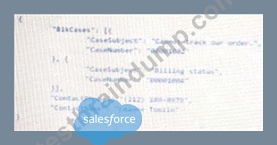
Refer to the exhibit below. What JSON from the DRGetContactDeteils action would display all six values correctly shown? BlkCases is a Repeat Block, and the names of the elements are the same as the label names without spaces.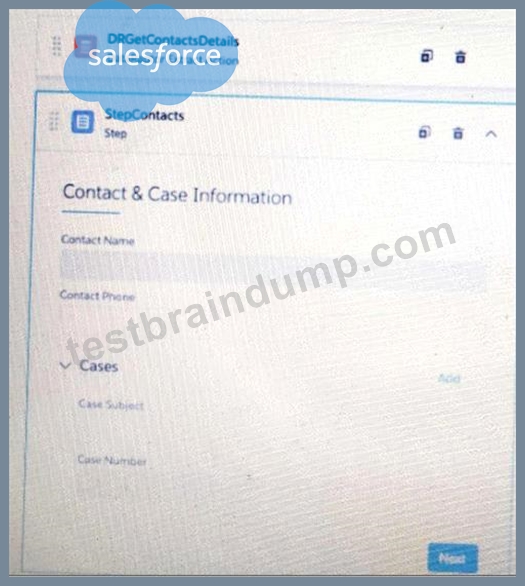
- A.
- B.
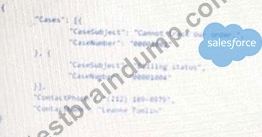
- C.

- D.

Answer: A
Explanation:
According to the OmniScript Data JSON page, the OmniScript structure JSON defines the data elements and their properties that are used in an OmniScript. The exhibit shows an OmniScript structure JSON with six elements: ContactName, ContactPhone, ContactEmail, CaseNumber, CaseSubject, and CaseStatus. The DRGetContactDetails action is a DataRaptor Extract action that retrieves data from the Contact and Case objects in Salesforce. The BlkCases element is a Repeat Block that displays a list of cases related to the contact. Therefore, the JSON from the DRGetContactDetails action that would display all six values correctly shown is option A, which has the following structure: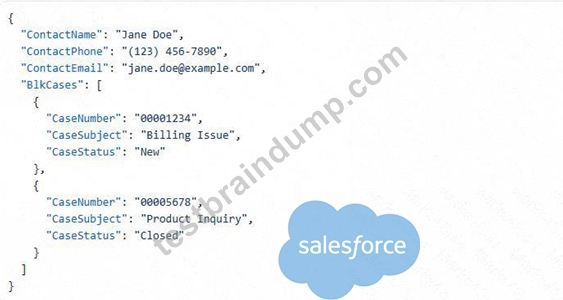
The other options have different structures that do not match the OmniScript structure shown.
NEW QUESTION # 26
You are building a DataRaptor Load for an Integration Procedure used in an OmniScript.
Based on best practices, how should you configure the Input JSON?
- A. Build the Input JSON node by node in an editor.
- B. Build the Input JSON node by node in the DataRaptor Designer.
- C. Copy the Input JSON from the OmniScript {Data} modal.
- D. Copy the Input JSON from the DataRaptor Action Debug node.
Answer: C
NEW QUESTION # 27
A developer is building an OmniScript and needs to save to Salesforce and to an AWS Order Management system.
Which OmniScriptelement could save all of this data?
- A. DataRaptor Load Action
- B. HTTP Action
- C. DataRaptor Post Action
- D. Integration Procedure Action
Answer: D
Explanation:
An Integration Procedure Action can execute an Integration Procedure that contains multiple elements, such as DataRaptor Actions, HTTP Actions, or other Integration Procedure Actions. This can be used to save data to multiple systems, such as Salesforce and AWS Order Management, in one OmniScript element.
NEW QUESTION # 28
Refer to theexhibit below. In this integration production structure, what Send JSON Path would be used to send the Output of the Action1 element to a Remote Action?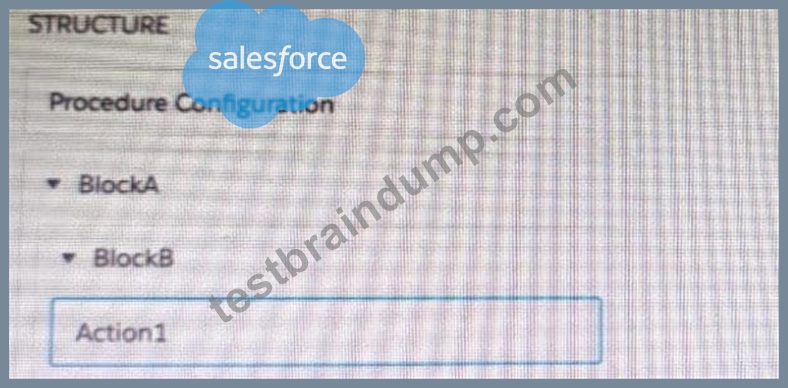
- A. BlockA: BlockB. Action 1
- B. BlockB:BlockB. Action1
- C. Action1: BlockB. Block A
- D. Action1. BlockB. Block A
Answer: C
Explanation:
Explanation
The correct syntax for the Send JSON Path is ActionName: BlockName, where ActionName is the name of the action element and BlockName is the name of the block element that contains the output data. The other options are either missing the colon or using incorrect names.
NEW QUESTION # 29
What is the merge code you need for this Integration Procedure structure to pass a CaseNumber node from the DataRaptor Extract Action Single Book (DRReadCase) to the HTTP Action's HTTP Path URL?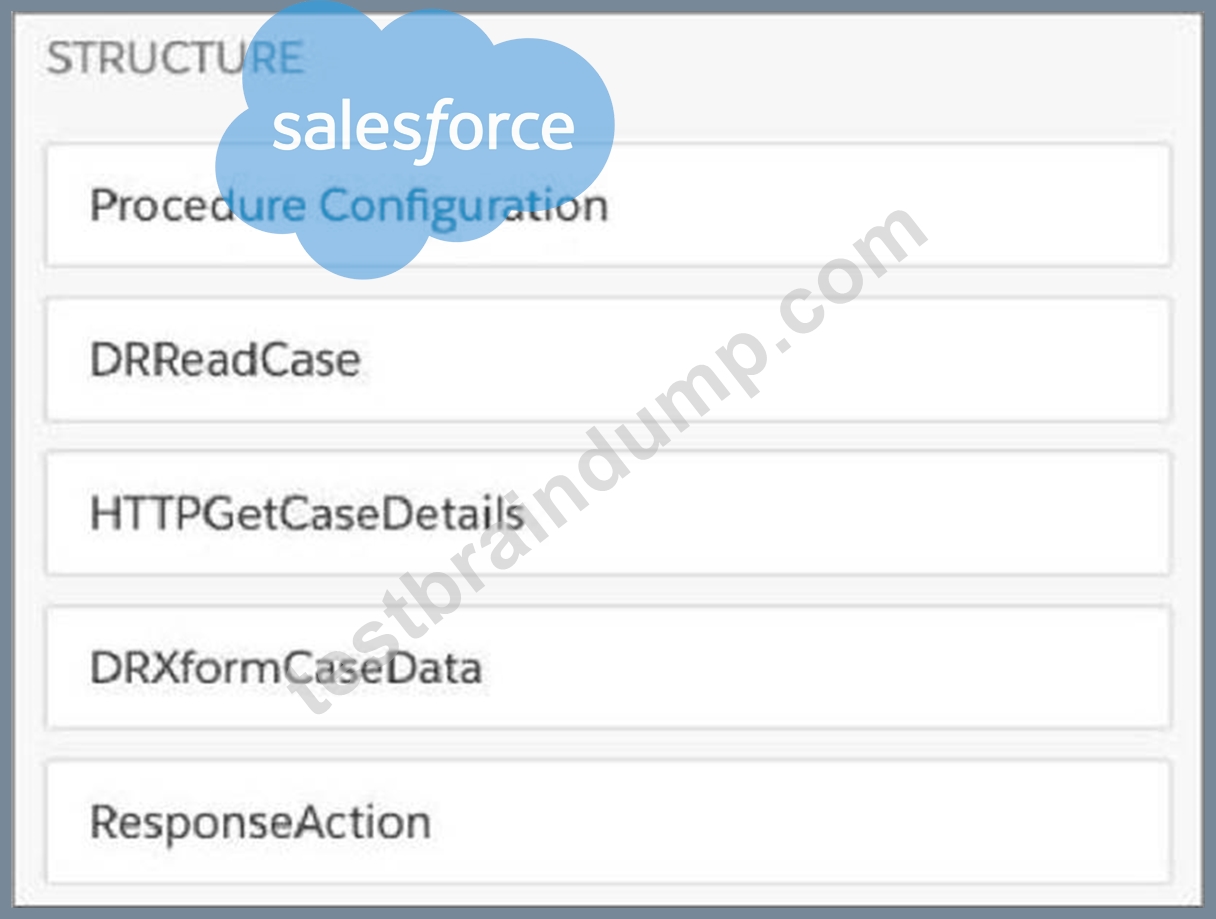
- A. %DRReadCase:CaseNumber%
- B. HTTPGetCaseDetails: CaseNumber
- C. {{DRReadCase. CaseNumber}}
- D. {{CaseNumben}
Answer: A
NEW QUESTION # 30
A developer is configuring an Integration Procedure Action in an OmniScript. The OmniScript needs a JSON response from the Integration Procedure but does not need to wait for the response for the user to proceed.
Which feature should the developer enable?
- A. Use Future
- B. Invoke Mode Fire and Forget
- C. Toast Completion
- D. Invoke Mode Non-Blocking
Answer: B
Explanation:
In OmniStudio, the Invoke Mode: Fire and Forget setting allows an OmniScript to call an Integration Procedure asynchronously, meaning it does not wait for the response to complete before continuing user interaction.
* C. Invoke Mode Fire and Forget - This is the correct setting. It's designed specifically for use cases where the user experience should not be blocked by backend processing.
Incorrect Options:
* A. Use Future is not a valid OmniScript configuration option.
* B. Invoke Mode Non-Blocking is not an official setting in OmniStudio terminology.
* D. Toast Completion is a UI notification setting and does not impact execution behavior.
:
OmniStudio Developer Guide # Integration Procedure Actions in OmniScripts
NEW QUESTION # 31
A developer is building an OmniScript and needs to retrieve data from a single field in aSalesforce record.
Which OmniScript element does this?
- A. Select
- B. HTTP Action
- C. DataRaptor Post Action
- D. Lookup
Answer: D
Explanation:
Explanation
The Lookup element is used to retrieve data from a single field in a Salesforce record. The Lookup element allows the developer to specify the object, field, and filter criteria for the data retrieval. The Select element is used to display a list of options for the user to choose from. The HTTP Action element is used to send or receive data from an external system using HTTP methods. The DataRaptor Post Action element is used to create or update Salesforce records using a DataRaptor Transform.
NEW QUESTION # 32
A developer is creating anOmniScript that Provisions trial orgs to their customers. The following text block in the OmniScript uses a merge code to display the ID for the new trial org:
Welcome to Salesforce
Your ID is %Details: Customer10:ID%
During testing, the developer noticesthat the ID does not display. The data JSON is structured as shown below.
How should the developer correct the merge code in order for the ID to display?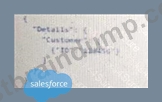
- A. To %%Details:Customer|n:ID%
- B. To %%Details:Customer|1:ID%
- C. To %%Details:Customer|0:ID%%
- D. To$Details:Customer|0:ID$
Answer: B
Explanation:
The merge code syntax for accessing an array element is %%Details:Customer|1:ID%%, where 1 is the index of the element. The index starts from 1, not 0, so the first element is Customer|1. The % sign is used for single- value merge codes, not array merge codes. The $ sign is used for variables, not merge codes.
NEW QUESTION # 33
......
Salesforce OmniStudio-Developer exam is designed to test the knowledge and skills of developers who specialize in the OmniStudio platform. Salesforce Certified OmniStudio Developer certification is intended for professionals who are responsible for developing, designing, and implementing custom solutions using the Salesforce platform. OmniStudio-Developer exam is a challenging test that requires a deep understanding of the Salesforce platform, as well as proficiency in using OmniStudio to create custom applications.
Verified OmniStudio-Developer Exam Dumps Q&As - Provide OmniStudio-Developer with Correct Answers: https://quiztorrent.testbraindump.com/OmniStudio-Developer-exam-prep.html
