
OGEA-103 Certification - The Ultimate Guide [Updated 2025]
OGEA-103 Practice Exam and Study Guides - Verified By TestBraindump
The Open Group OGEA-103 exam is a comprehensive certification program that covers the TOGAF enterprise architecture framework. TOGAF Enterprise Architecture Combined Part 1 and Part 2 Exam certification is designed for professionals who are involved in enterprise architecture and are looking to enhance their skills and knowledge in this field. TOGAF Enterprise Architecture Combined Part 1 and Part 2 Exam certification covers both Part 1 and Part 2 of the TOGAF framework, making it an all-encompassing exam.
The Open Group OGEA-103 Exam is a certification program designed for professionals who want to validate their knowledge and skills in enterprise architecture. It is a combined exam that covers both Part 1 and Part 2 of the TOGAF Enterprise Architecture certification. TOGAF Enterprise Architecture Combined Part 1 and Part 2 Exam certification is highly regarded in the industry and is recognized worldwide as a standard for enterprise architecture.
NEW QUESTION # 52
Please read this scenario prior to answering the question
You have been appointed as senior architect working for an autonomous driving technology development company. The mission of the company is to build an industry leading unified technology and software platform to support connected cars and autonomous driving.
The company uses the TOGAF Standard as the basis for its Enterprise Architecture (EA) framework.
Architecture development within the company follows the purpose-based EA Capability model as described in the TOGAF Series Guide: A Practitioners'Approach to Developing Enterprise Architecture Following the TOGAF ADM.
An architecture to support strategy has been completed defining a long-range Target Architecture with a roadmap spanning five years. This has identified the need for a portfolio of projects over the next twoyears.
The portfolio includes development of travel assistance systems using swarm data from vehicles on the road.
The current phase of architecture development is focused on the Business Architecture which needs to support the core travel assistance services that the company plans to provide. The core services will manage and process the swarm data generated by vehicles, paving the way for autonomous driving in the future.
The presentation and access to different variations of data that the company plans to offer through its platform poses an architecture challenge. The application portfolio needs to interact securely with various third-party cloud services, and V2X (Vehicle-to-Everything) service providers in many countries to be able to manage the data at scale. The security of V2X is a key concern for the stakeholders. Regulators have stated that the user's privacy be always protected, for example, so that the drivers' journey cannot be tracked or reconstructed by compiling data sent or received by the car.
Refer to the scenario
You have been asked to describe the risk and security considerations you would include in the current phase of the architecture development?
Based on the TOGAF standard which of the following is the best answer?
- A. You will focus on data quality as it is a key factor in risk management. You will identify the datasets that need to be safeguarded. For each dataset, you will assign ownership and responsibility for the quality of data needs. A security classification will be defined and applied to each dataset. The dataset owner will then be able to authorize processes that are trusted for a certain activity on the dataset under certain circumstances.
- B. You will create a security domain model so that assets with the same level can be managed under one security policy. Since data is being shared across partners, you will establish a security federation to include them. This would include contractual arrangements, and a definition of the responsibility areas for the data exchanged, as well as security implications. You would undertake a risk assessment determining risks relevant to specific data assets.
- C. You will perform a qualitative risk assessment for the data assets exchanged with partners. This will deliver a set of priorities, high to medium to low, based on identified threats, the likelihood of occurrence, and the impact if it did occur. Using the priorities, you would then develop a Business Risk Model which will detail the risk strategy including classifications to determine what mitigation is enough.
- D. You will focus on the relationship with the third parties required for the travel assistance systems and define a trust framework. This will describe the relationship with each party. Digital certificates are a key part of the framework and will be used to create trust between parties. You will monitor legal and regulatory changes across all the countries to keep the trust framework in compliance.
Answer: B
Explanation:
A security domain model is a technique that can be used to define the security requirements and policies for the architecture. A security domain is a grouping of assets that share a common level of security and trust. A security policy is a set of rules and procedures that govern the access and protection of the assets within a security domain. A security domain model can help to identify the security domains, the assetswithin each domain, the security policies for each domain, and the relationships and dependencies between the domains1 Since the data is being shared across partners, a security federation is needed to establish a trust relationship and a common security framework among the different parties. A security federation is a collection of security domains that have agreed to interoperate under a set of shared security policies and standards. A security federation can enable secure data exchange and collaboration across organizational boundaries, while preserving the autonomy and privacy of each party. A security federation requires contractual arrangements, and a definition of the responsibility areas for the data exchanged, as well as security implications2 A risk assessment is a process that identifies, analyzes, and evaluates the risks that may affect the architecture.
A risk assessment can help to determine the likelihood and impact of the threats and vulnerabilities that may compromise the security and privacy of the data assets. A risk assessment can also help to prioritize and mitigate the risks, and to monitor and review the risk situation3 Therefore, the best answer is D, because it describes the risk and security considerations that would be included in the current phase of the architecture development, which is focused on the Business Architecture.
The answer covers the security domain model, the security federation, and the risk assessment techniques that are relevant to the scenario.
References: 1: The TOGAF Standard, Version 9.2, Part III: ADM Guidelines and Techniques, Chapter 35:
Security Architecture and the ADM 2: The TOGAF Standard, Version 9.2, Part IV: Architecture Content Framework, Chapter 38: Security Architecture 3: The TOGAF Standard, Version 9.2, Part III: ADM Guidelines and Techniques, Chapter 32: Risk Management
NEW QUESTION # 53
Complete the sentence. Actions arising from the Business Transformation Readiness Assessment technique should be incorporated in the
- A. Architecture Roadmap
- B. Implementation and Migration Plan
- C. Architecture Requirements Specification
- D. Implementation Governance Model
Answer: B
Explanation:
The Business Transformation Readiness Assessment technique is used to evaluate the readiness of the organization to undergo change and to identify the actions needed to increase the likelihood of a successful business transformation. These actions should be incorporated in the Implementation and Migration Plan, which is the detailed plan to transition from the Baseline Architecture to the Target Architecture. The Implementation and Migration Plan also includes the Transition Architectures, the Architecture Building Blocks, the Work Packages, the Implementation Governance Model, and the Architecture Contract12 References: 1: The TOGAF Standard, Version 9.2, Part III: ADM Guidelines and Techniques, Chapter 27: Business Transformation Readiness Assessment 2: The TOGAF Standard, Version 9.2, Part II:
Architecture Development Method (ADM), Chapter 21: Phase F: Migration Planning
NEW QUESTION # 54
Please read this scenario prior to answering the question
You are the Lead Enterprise Architect at a major agribusiness company. The company's main harvest is lentils, a highly valued food grown worldwide. The lentil parasite, broomrape, has been an increasing concern for many years and is now becoming resistant to chemical controls. In addition, changes in climate favor the propagation and growth of the parasite. As a result, the parasite cannot realistically be exterminated, and it has become pandemic, with lentil yields falling globally.
In response to the situation, the CEO has decided that the lentil fields will be used for another harvest. The company will also cease to process third-party lentils and will repurpose its processing plants. Thus, the target market will change, and the end-products will be different and more varied.
The company has recently established an Enterprise Architecture practice based on the TOGAF standard as method and guiding framework. The CIO is the sponsor of the activity. A formal request for architecture change has been approved. At this stage there is no fixed scope, shared vision, or objectives.
Refer to the scenario
You have been asked to propose the best approach for architecture development to realize the CEO's change in direction for the company.
Based on the TOGAF standard which of the following is the best answer?
- A. You propose that the priority is to produce a new Request for Architecture Work leading to development of a new Architecture Vision. The trade-off method should be applied to identify and select an architecture satisfying the stakeholders. For an efficient change the EA team should be aligned with the organization's planning, budgeting, operational, and change processes.
- B. You propose that the team uses the architecture definition document and focus on architecture development starting simultaneously phases B, C and D. This is because the CEO has identified the need to change. This will ensure that the change can be defined in a structured manner and address the requirements needed to realize the change.
- C. You propose that the team focus on architecture definition including development of business models, with emphasis on defining the change parameters to support this new business strategy that the CEO has identified. Once understood, the team will be in the best position to identify the requirements, drivers, issues, and constraints for the change.
- D. You propose that this engagement define the baseline Technology Architecture first in order to assess the current infrastructure capacity and capability for the company. Then the focus should be on transition planning and incremental architecture deployment. This will identify requirements to ensure that the projects are sequenced in an optimal fashion so as to realize the change.
Answer: A
Explanation:
Explanation
A Request for Architecture Work is a document that describes the scope, approach, and expected outcomes of an architecture project. A Request for Architecture Work is usually initiated by the sponsor or client of the architecture work, and approved by the Architecture Board, which is a governance body that oversees the architecture work and ensures compliance with the architecture principles, standards, and goals. A Request for Architecture Work triggers a new cycle of the Architecture Development Method (ADM), which is the core process of the TOGAF standard that guides the development and management of the enterprise architecture12 An Architecture Vision is a high-level description of the desired outcomes and benefits of the proposed architecture. An Architecture Vision is the output of Phase A: Architecture Vision of the ADM cycle, which is the first phase of the architecture development. An Architecture Vision defines the scope and approach of the architecture work, and establishes the business goals and drivers that motivate the architecture work. An Architecture Vision also involves obtaining the approval and commitment of the sponsors and other key stakeholders, and initiating the Architecture Governance process3 A trade-off analysis is a technique that can be used to evaluate and compare different architecture alternatives and select the most suitable one. A trade-off analysis involves identifying the criteria and factors that are relevant to the decision, such as costs, benefits, risks, and opportunities, and assessing the strengths and weaknesses of each alternative. A trade-off analysis also involves balancing and reconciling the multiple, often conflicting, requirements and concerns of the stakeholders, and ensuring alignment with the Architecture Vision and the Architecture Principles.
Therefore, the best answer is D, because it proposes the best approach for architecture development to realize the CEO's change in direction for the company. The answer covers the Request for Architecture Work, the Architecture Vision, and the trade-off analysis techniques that are relevant to the scenario.
References: 1: The TOGAF Standard, Version 9.2, Part II: Architecture Development Method (ADM), Chapter 7: Request for Architecture Work 2: The TOGAF Standard, Version 9.2, Part VI: Architecture Capability Framework, Chapter 50: Architecture Governance 3: The TOGAF Standard, Version 9.2, Part II:
Architecture Development Method (ADM), Chapter 18: Phase A: Architecture Vision : The TOGAF Standard, Version 9.2, Part III: ADM Guidelines and Techniques, Chapter 30: Trade-Off Analysis
NEW QUESTION # 55
Consider the following statements:
1. Each contracted party is required to act responsibly to the organization and its stakeholders.
2. All decisions taken, processes used, and their implementation will not be allowed to create unfair advantage to any one particular party.
3. Digital Transformation and operations will be more effective and efficient.
4. Strategic decision-making by C-Level executives and business leaders will be more effective.
Which statements highlight the value and necessity for Architecture Governance to be adopted within organizations?
- A. 1 & 4
- B. 1 & 2
- C. 2 & 3
- D. 3 & 4
Answer: B
Explanation:
Architecture governance is the practice of ensuring compliance with the enterprise architecture and its principles, standards, and goals. Architecture governance provides the means to establish, monitor, and control the architecture development and implementation processes, and to resolve any issues or conflicts that may arise. Architecture governance also ensures that all stakeholders are represented and involved in the decision-making process, and that their interests and concerns are balanced and aligned. Statements 1 and 2 highlight the value and necessity for architecture governance to be adopted within organizations, as they emphasize the importance of responsibility, accountability, fairness, and transparency in the architectural activities. Statements 3 and 4 are more related to the benefits and outcomes of having a good enterprise architecture, rather than the governance aspect.References: : The TOGAF Standard, Version 9.2, Part VI:
Architecture Capability Framework, Chapter 50: Architecture Governance : The TOGAF Standard, Version
9.2, Part III: ADM Guidelines and Techniques, Chapter 29: Architecture Governance
NEW QUESTION # 56
In which part of the ADM cycle do building block gaps become associated with work packages that will address the gaps?
- A. Phases B C and D
- B. Phases F
- C. Phase E
- D. Phases G and H
Answer: C
Explanation:
In Phase E of the ADM cycle, building block gaps become associated with work packages that will address the gaps. This phase involves creating an Implementation and Migration Plan that defines a set of work packages and Transition Architectures that will deliver the Target Architecture. Reference: The TOGAF Standard | The Open Group Website, Section 3.2.5 Phase E: OpportunitiesandSolutions.
NEW QUESTION # 57
What is defined as the effect of uncertainty on objectives?
- A. Risk
- B. Threat
- C. Continuity
- D. Vulnerability
Answer: A
Explanation:
Risk is defined as the effect of uncertainty on objectives, according to the ISO 31000 standard, which provides principles and guidelines for risk management1 Risk can be positive or negative, depending on whether the uncertainty affects the achievement or the failure of the objectives. Risk can also be expressed in terms of likelihood and impact, which indicate the probability and the consequence of the risk occurrence. Risk management is the coordinated activities to direct and control an organization with regard to risk. Risk management is an integral part of the TOGAF standard, as it helps to identify, assess, and treat the risks that may affect the architecture development and implementation2 References: 1: ISO 31000:2018, Risk management - Guidelines, Clause 3.1 2: The TOGAF Standard, Version 9.2, Part III: ADM Guidelines and Techniques, Chapter 32: Risk Management
NEW QUESTION # 58
Please read this scenario prior to answering the question
Your role is that of a consultant to the Lead Enterprise Architect to an international supplier of engineering services and automated manufacturing systems. It has three manufacturing plants where it assembles both standard and customized products for industrial production automation. Each of these plants has been operating its own planning and production scheduling systems, as well as applications and control systems that drive the automated production line.
The Enterprise Architecture department has been operating for several years and has mature, well-developed architecture governance and development processes that are based on the TOGAF Standard. The CIO sponsors the Enterprise Architecture.
During a recent management meeting, a senior Vice-President highlighted an interview where a competitor company's CIO is reported as saying that their production efficiency had been improved by replacing multiple planning and scheduling systems with a common Enterprise Resource Planning (ERP) system located in a central data center. Some discussion followed, with the CIO responding that the situations are not comparable, and the current architecture is already optimized.
In response, the Architecture Board approved a Request for Architecture Work covering the investigations to determine if such an architecture transformation would lead to improvements in efficiency. You have been assigned to support the architecture team working on this project.
A well-known concern of the plant managers is about the security and reliability of driving their planning and production scheduling from a remote centralized system. Any chosen system would also need to support the current supply chain network consisting of local partners at each of the plants.
Refer to the scenario
You have been asked to explain how you will initiate the architecture project.
Based on the TOGAF Standard, which of the following is the best answer?
- A. You would hold a series of interviews at each of the manufacturing plants using the business scenarios technique. This will allow you to understand the systems and integrations with local partners. You would use stakeholder analysis to identify key players in the engagement, and to understand their concerns. You will then identify and document the key high-level stakeholder requirements for the architecture. You will then generate high level definitions of the baseline and target architectures.
- B. You would conduct a pilot project that will enable vendors to demonstrate potential off-the-shelf solutions that address the concerns of the stakeholders. Running a pilot project will save time and money later in the process. Based on the findings of that pilot project, a complete set of requirements can then be developed that will drive the evolution of the architecture. Once the requirements are completed, a formal stakeholder review should be held, and permission sought to proceed to develop the target architecture.
- C. You would develop baseline and target Architectures for each of the manufacturing plants, ensuring that the views corresponding to selected viewpoints address key concerns of the stakeholders. A business case, together with performance metrics and measures should be defined to ensure the architecture meets the business needs. A consolidated gap analysis between the architectures will then validate the approach and determine the capability increments needed to achieve the target state.
- D. You would research vendor literature and conduct a series of briefings with vendors that are on the current approved supplier list. Based on the findings from the research, you would define a preliminary Architecture Vision including summary views, high-level requirements, and high-level definitions of the baseline and target environments from a business, information systems, and technology perspective. You would then use that to build consensus among the key stakeholders.
Answer: A
Explanation:
The best answer is C. You would hold a series of interviews at each of the manufacturing plants using the business scenarios technique. This will allow you to understand the systems and integrations with local partners. You would use stakeholder analysis to identify key players in the engagement, and to understand their concerns. You will then identify and document the key high-level stakeholder requirements for the architecture. You will then generate high level definitions of the baseline and target architectures.
This answer is based on the TOGAF standard, which recommends the following steps to initiate the architecture project1:
Establish the architecture project
Identify stakeholders, concerns, and business requirements
Confirm and elaborate business goals, business drivers, and constraints Evaluate business capabilities Assess readiness for business transformation Define scope Confirm and elaborate Architecture Principles, including business principles Develop Architecture Vision Define the Target Architecture value propositions and KPIs Identify the business transformation risks and mitigation activities Secure stakeholder and sponsor approval The answer C covers most of these steps, by using the business scenarios technique to elicit and validate the business requirements, goals, drivers, and constraints, as well as the current and future states of the architecture2. The answer C also uses stakeholder analysis to identify and engage the key stakeholders, and to address their concerns and expectations3. The answer C also generates high level definitions of the baseline and target architectures, which can be used to develop the Architecture Vision and the value propositions4.
The other answers are not the best approach for architecture development, because:
Answer A focuses on researching vendor literature and conducting briefings with vendors, which is not the best way to understand the business needs and the current situation of the enterprise. Answer A also defines a preliminary Architecture Vision without involving the stakeholders or validating the requirements, which may lead to misalignment and lack of consensus.
Answer B conducts a pilot project that will enable vendors to demonstrate potential solutions, which is premature and costly at this stage of the architecture project. Answer B also does not address the stakeholder concerns or the current systems and integrations, which may result in gaps and risks. Answer B also develops the requirements after the pilot project, which may not reflect the actual business needs and goals.
Answer D develops baseline and target architectures for each of the manufacturing plants, which may not consider the enterprise-wide perspective and the potential benefits of a common ERP system. Answer D also does not involve the stakeholders or address their concerns, which may result in resistance and conflict. Answer D also does not define the business case or the performance metrics, which are essential for demonstrating the value and feasibility of the architecture.
NEW QUESTION # 59
Which ADM phase focuses on defining the problem to be solved, identifying the stakeholders, their concerns, and requirements?
- A. Phase
- B. Phase
- C. Phase A
- D. Preliminary Phase
Answer: C
Explanation:
Phase A: Architecture Vision is the first phase of the Architecture Development Method (ADM) cycle, which is the core of the TOGAF standard. The main purpose of this phase is to define the scope and approach of the architecture development, and to create the Architecture Vision, which is a high-level description of the desired outcomes and benefits of the proposed architecture. To achieve this purpose, this phase focuses on defining the problem to be solved, identifying the stakeholders, their concerns, and requirements, and establishing the business goals and drivers that motivate the architecture work. This phase also involves obtaining the approval and commitment of the sponsors and other key stakeholders, and initiating the Architecture Governance process.
The TOGAF Standard, Version 9.2, Part II: Architecture Development Method (ADM), Chapter 5:
Introduction to the ADM : The TOGAF Standard, Version 9.2, Part II: Architecture Development Method (ADM), Chapter 18: Phase A: Architecture Vision : The TOGAF Standard, Version 9.2, Part II: Architecture Development Method (ADM), Chapter 18.3: Inputs : The TOGAF Standard, Version 9.2, Part II: Architecture Development Method (ADM), Chapter 18.4: Steps
NEW QUESTION # 60
Complete the sentence A set of architecture principles that cover every situation perceived meets the recommended criteria of_______________
- A. completeness
- B. stability
- C. consistency
- D. robustness
Answer: A
Explanation:
A set of architecture principles that cover every situation perceived meets the recommended criteria of completeness. Completeness is one of the six criteria that should be applied when developing or assessing architecture principles. Completeness means that there are no gaps or overlaps in the coverage of principles across all relevant aspects of the enterprise's architecture. Reference: The TOGAF Standard | The Open Group Website, Section 3.3.7 Architecture Principles.
NEW QUESTION # 61
What is used to structure architectural information in an orderly way so that it can be processed to meet stakeholder needs?
- A. An EA Library
- B. Content Metamodel
- C. An Architecture Framework
- D. A Stakeholder Map
Answer: C
Explanation:
An Architecture Framework is used to structure architectural information in an orderly way so that it can be processed to meet stakeholder needs. An Architecture Framework provides a common language and taxonomy for describing architectures; a set of tools and techniques for creating architectures; a method for defining views and viewpoints for different stakeholders; a metamodel for representing architecture artifacts; a repository for storing and managing architecture artifacts; and a governance framework for controlling architecture development and evolution. Reference: The TOGAF Standard | The Open Group Website, Section 2 Core Concepts.
NEW QUESTION # 62
Refer to the table below: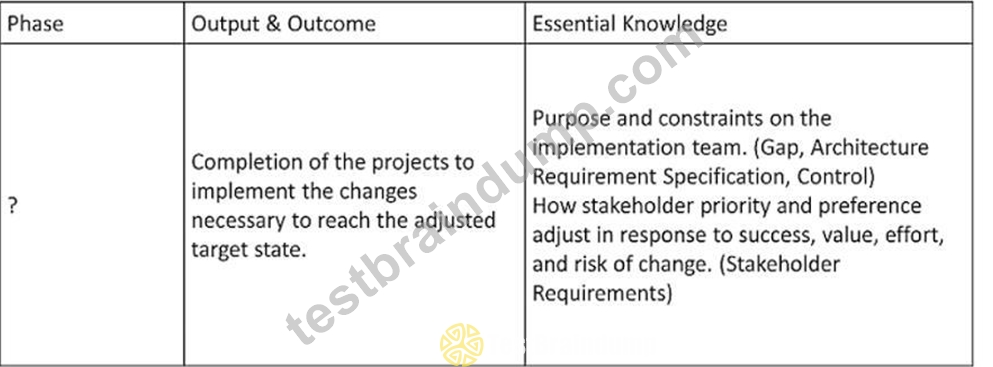
Which ADM Phase does this describe?
- A. Phase G
- B. Phase F
- C. Phase E
- D. Phase A
Answer: A
Explanation:
The table describes the output, outcome, and essential knowledge of an ADM phase that oversees the implementation of changes necessary to reach the adjusted target state. This corresponds to Phase G, also known as Implementation Governance, which ensures that the architecture defined in earlier phases is realized, and it oversees the development and implementation of projects to align with this architecture. The essential knowledge required during this phase includes understanding constraints on the implementation team and adjusting stakeholder priority and preference in response to success, value, effort, and risk of change.
References: TOGAF Version 9.1 - 1
NEW QUESTION # 63
Which ADM phase focuses on defining the problem to be solved, identifying the stakeholders, their concerns, and requirements?
- A. Phase
- B. Phase
- C. Phase A
- D. Preliminary Phase
Answer: C
Explanation:
Phase A: Architecture Vision is the first phase of the Architecture Development Method (ADM) cycle, which is the core of the TOGAF standard. The main purpose of this phase is to define the scope and approach of the architecture development, and to create the Architecture Vision, which is a high-level description of the desired outcomes and benefits of the proposed architecture. To achieve this purpose, this phase focuses on defining the problem to be solved, identifying the stakeholders, their concerns, and requirements, and establishing the business goals and drivers that motivate the architecture work. This phase also involves obtaining the approval and commitment of the sponsors and other key stakeholders, and initiating the Architecture Governance process.
References: : The TOGAF Standard, Version 9.2, Part II: Architecture Development Method (ADM), Chapter 5: Introduction to the ADM : The TOGAF Standard, Version 9.2, Part II: Architecture Development Method (ADM), Chapter 18: Phase A: Architecture Vision : The TOGAF Standard, Version 9.2, Part II:
Architecture Development Method (ADM), Chapter 18.3: Inputs : The TOGAF Standard, Version 9.2, Part II:
Architecture Development Method (ADM), Chapter 18.4: Steps
NEW QUESTION # 64
You are working as an Enterprise Architect within an Enterprise Architecture (EA) team at a multinational energy company. The company is committed to becoming a net-zero emissions energy business by 2050. To achieve this, the company is focusing on shifting to renewable energy production and adopting eco-friendly practices.
The EA team, which reports to the Chief Technical Officer (CTO), has been tasked with overseeing the transformation to make the company more effective through acquisitions. The company plans to fully integrate these acquisitions, including merging operations and systems.
To address the integration challenges, the EA team leader wants to know how to manage risks and ensure that the company succeeds with the proposed changes. Based on the TOGAF Standard, which of the following is the best answer?
- A. The EA team should develop Business Architecture views that demonstrate how stakeholder concerns are addressed and assess each factor for readiness, urgency, and degree of difficulty.
- B. The EA team should evaluate the company's readiness for change by identifying factors that will impact the transformation. These factors will be used to determine initial risks associated with the initiative.
- C. The EA team should document the risks associated with the transformation in an Implementation Factor Catalog to inform decisions during implementation and deployment.
- D. The EA team should create a Business Scenario to fully describe the business problem that is being addressed by the transformation. Once requirements are identified, they should be evaluated in terms of risks. Any residual risks should be escalated to the Architecture Board.
Answer: D
Explanation:
In TOGAF, creating a Business Scenario is a foundational step in defining and understanding the business problem, especially for complex transformations involving multiple stakeholders andsystems, such as in this scenario. This method aligns with Phase A (Architecture Vision) of the TOGAF Architecture Development Method (ADM). Here's why this approach is the most effective:
Understanding Business Requirements:A Business Scenario provides a structured way to capture and analyze the business requirements, stakeholder concerns, and the contextual elements related to the problem. In this scenario, the company faces challenges in integrating newly acquired companies with existing operations, which includes complex stakeholder concerns across different functional areas. Developing a Business Scenario allows the EA team to break down these complexities into identifiable and manageable parts.
Risk Evaluation and Management:By using the Business Scenario approach, the EA team can not only define the requirements but also assess associated risks systematically. TOGAF emphasizes the importance of risk management through identifying potential risks, evaluating their impact, and defining strategies for handling these risks. The process includes assessing how risks can be avoided, transferred, or reduced-a necessary step in large-scale transformations to ensure that risks are proactively managed.
Residual Risks and Governance:Any risks that cannot be fully resolved should be identified as residual risks and escalated to the Architecture Board, which is aligned with TOGAF's governance approach. The Architecture Board's role in TOGAF is to provide oversight and make critical decisions on risks that exceed the control of the EA team. This ensures that unresolved risks are managed at the appropriate level of the organization.
Alignment with TOGAF ADM Phases:The Business Scenario approach directly aligns with the Preliminary and Architecture Vision phases of the TOGAF ADM, which focuses on establishing a baseline understanding of the business context and the strategic transformation required. The detailed understanding of requirements, stakeholder concerns, and risks identified here will guide the subsequent phases of the ADM, including Business Architecture and Information Systems Architecture.
TOGAF Reference (Section 2.6, ADM Techniques):TOGAF provides guidelines on the creation of Business Scenarios as part of ADM Techniques, highlighting the importance of defining a business problem comprehensively to ensure successful transformation. This method includes identification of stakeholders, business requirements, and associated risks, which aligns well with the company's need for strategic and systematic integration of new business units.
By utilizing a Business Scenario, the EA team ensures that all aspects of the transformation are well understood, risks are identified early, and residual risks are managed effectively, aligning with the company's strategic objectives and the TOGAF framework's guidance on risk management and stakeholder alignment.
NEW QUESTION # 65
Consider the following statements:
1. Each contracted party is required to act responsibly to the organization and its stakeholders.
2. All decisions taken, processes used, and their implementation will not be allowed to create unfair advantage to any one particular party.
3. Digital Transformation and operations will be more effective and efficient.
4. Strategic decision-making by C-Level executives and business leaders will be more effective.
Which statements highlight the value and necessity for Architecture Governance to be adopted within organizations?
- A. 1 & 4
- B. 1 & 2
- C. 2 & 3
- D. 3 & 4
Answer: B
Explanation:
Architecture governance is the practice of ensuring compliance with the enterprise architecture and its principles, standards, and goals. Architecture governance provides the means to establish, monitor, and control the architecture development and implementation processes, and to resolve any issues or conflicts that may arise. Architecture governance also ensures that all stakeholders are represented and involved in the decision-making process, and that their interests and concerns are balanced and aligned. Statements 1 and 2 highlight the value and necessity for architecture governance to be adopted within organizations, as they emphasize the importance of responsibility, accountability, fairness, and transparency in the architectural activities. Statements 3 and 4 are more related to the benefits and outcomes of having a good enterprise architecture, rather than the governance aspect.
Reference: : The TOGAF Standard, Version 9.2, Part VI: Architecture Capability Framework, Chapter 50: Architecture Governance : The TOGAF Standard, Version 9.2, Part III: ADM Guidelines and Techniques, Chapter 29: Architecture Governance
NEW QUESTION # 66
What should be put in place through organization structures, roles, responsibilities, skills and processes to carry out architectural activity effectively?
- A. An Enterprise Architecture
- B. An EA Capability
- C. An EA repository
- D. An EA framework
Answer: B
Explanation:
An EA Capability is the ability of an organization to perform enterprise architecture effectively and efficiently. It involves establishing and maintaining the appropriate organization structures, roles, responsibilities, skills, processes, tools, and governance mechanisms to support the development and use of enterprise architecture. An EA Capability enables the organization to align its business and IT strategies, deliver value from its investments, manage change and complexity, and improve its performance and agility12 Reference: 1: The TOGAF Standard, Version 9.2, Part VI: Architecture Capability Framework, Chapter 44: Introduction 2: The TOGAF Standard, Version 9.2, Part VI: Architecture Capability Framework, Chapter 45: Establishing and Maintaining an Enterprise Architecture Capability
NEW QUESTION # 67
Complete the sentence A business scenario describes______________
- A. general rules and guidelines tor the architecture being developed
- B. business and technology environment in which those problems occur
- C. business domain gaps such as cross-training requirements
- D. shortfalls between the Baseline and Target Architectures
Answer: B
NEW QUESTION # 68
Consider the following statements.
1. All processes, decision-making, and mechanisms used will be established so as to minimize or avoid potential conflicts of interest.
2. More effective strategic decision-making will be made by C-Level executives and business leaders.
3. All actions implemented and their decision support will be available for inspection by authorized organization and provider parties.
4. Digital Transformation and operations will be more effective and efficient.
Which statements highlight the value and necessity for Architecture Governance to be adopted within organizations?
- A. 1 & 4
- B. 1 & 3
- C. 2& 3
- D. 2 & 4
Answer: B
Explanation:
Statements 1 and 3 highlight the value and necessity for Architecture Governance to be adopted within organizations. Architecture Governance is the practice and orientation by which Enterprise Architectures and other architectures are managed and controlled at an enterprise-wide level12. It ensures that architectural decisions are aligned with the organization's strategy, objectives, and standards. Architecture Governance also involves establishing and maintaining processes, decision-making, and mechanisms to avoid or minimize potential conflicts of interest, such as between different stakeholders, business units, or projects34. Moreover, Architecture Governance requires transparency and accountability for all actions implemented and their decision support, so that they can be inspected and evaluated by authorized parties, such as auditors, regulators, or customers5 . References:
*The TOGAF Standard, Version 9.2 - Architecture Governance - The Open Group
*Architecture Governance - The Open Group
*Tutorial: Governance in TOGAF's Architecture Development Method (ADM)
*Architecture Governance in TOGAF: Ensuring Effective Management and Compliance
*The TOGAF Standard, Version 9.2 - Definitions - The Open Group
*[Architecture Governance in TOGAF: Ensuring Alignment and Control]
NEW QUESTION # 69
Consider the following statements:
1. Groups of countries, governments, or governmental organizations (such as militaries) working together to create common or shareable deliverables or infrastructures
2. Partnerships and alliances of businesses working together, such as a consortium or supply chain What are those examples of according to the TOGAF Standard?
- A. Enterprises
- B. Organizations
- C. Business Units
- D. Architectures Scopes
Answer: A
Explanation:
According to the TOGAF standard, the two statements provided refer to different scopes within which architecture can be developed:
Groups of countries, governments, or governmental organizations working together typically align with broader, often international, scopes of architecture that transcend individual enterprise boundaries.
Partnerships and alliances of businesses working together, such as a consortium or supply chain, refer to collaborative efforts that can define architecture at a scope involving multiple enterprises.
In both cases, the term "Architectures Scopes" is appropriate because it reflects the varying levels and contexts in which architectures can be defined, ranging from single business units to collaborative inter- organizational efforts.
NEW QUESTION # 70
Consider the following chart: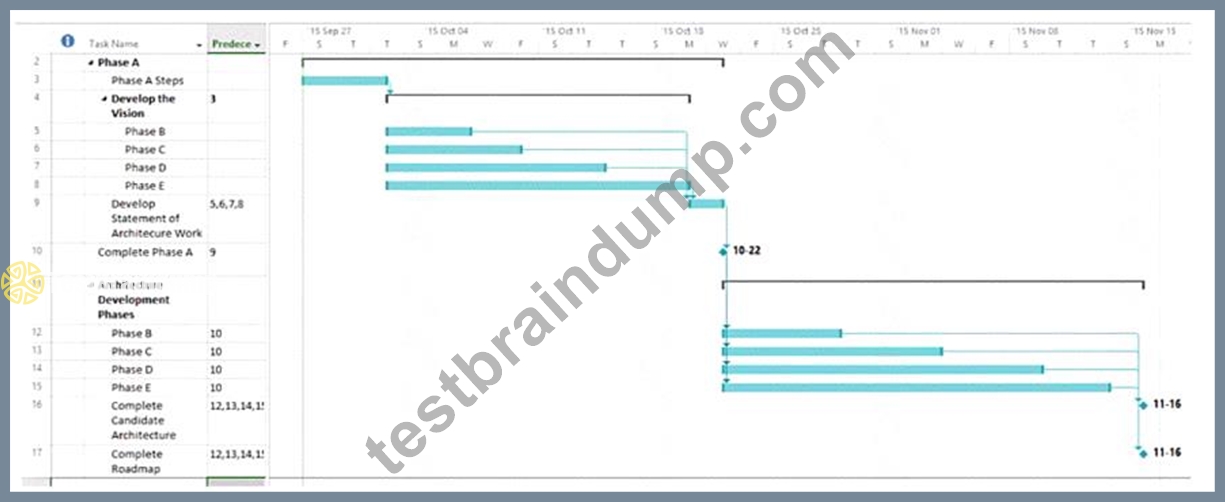
Which important concept for Enterprise Architecture Practitioners does it illustrate?
- A. ADM phases must be run in a sequenced approach to produce the Architecture.
- B. ADM phases must be run simultaneously until the relevant information has been produced.
- C. Enterprise Architects must use Gantt charts to communicate with Stakeholders.
- D. An Enterprise Architecture must be developed in phases with a limited fixed duration.
Answer: A
Explanation:
The chart shown is a Gantt chart, which is commonly used for project management to illustrate a project schedule. In the context of TOGAF (The Open Group ArchitectureFramework), which is a framework for enterprise architecture, this Gantt chart is demonstrating the sequenced approach to the Architecture Development Method (ADM). The ADM is the core process of TOGAF which provides a tested and repeatable process for developing architectures. The ADM is described as being iterative, over the whole process, between phases, and within phases. For each iteration of the ADM, a fresh decision must be taken about each of the parameters (scope, granularity, time period, and architecture assets).
The ADM consists of a number of phases that have to be followed in sequence:
Preliminary Phase: Framework and principles
Phase A: Architecture Vision
Phase B: Business Architecture
Phase C: Information Systems Architectures, including Data and Application Architectures Phase D: Technology Architecture Phase E: Opportunities and Solutions Phase F: Migration Planning Phase G: Implementation Governance Phase H: Architecture Change Management Requirements Management Each phase is dependent on the outputs of the previous phase and the Requirements Management phase runs throughout. The Gantt chart clearly shows the dependency and sequence in which these phases occur, implying that a structured approach is followed to produce the enterprise architecture.
References:
The TOGAF Standard, Version 9.2, a standard of The Open Group
The TOGAF documentation available at https://publications.opengroup.org/standards/architecture andhttps://publications.opengroup.org/guides/architecture
NEW QUESTION # 71
Consider the following ADM phases objectives.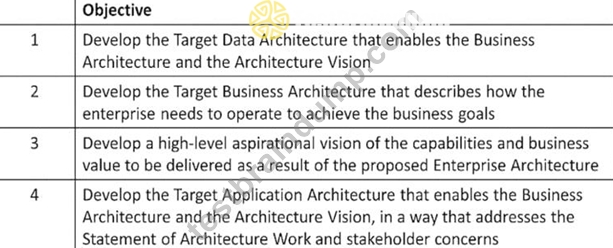
Which phase does each objective match?
- A. 1C-2B-3A-4C
- B. 1C-2D-3B-4A
- C. 1B-2D-3A-4C
- D. 1A-2B-3C-4D
Answer: A
Explanation:
The objectives listed in the question correspond to the objectives of different phases of the TOGAF ADM (Architecture Development Method), which is a method for developing and managing an enterprise architecture1.
The ADM consists of nine phases, each with a specific purpose and output. The phases are1:
Preliminary Phase: To prepare and initiate the architecture development cycle, including defining the architecture framework, principles, and governance.
Phase A: Architecture Vision: To define the scope, vision, and stakeholders of the architecture initiative, and to obtain approval to proceed.
Phase B: Business Architecture: To describe the baseline and target business architecture, and to identify the gaps between them.
Phase C: Information Systems Architectures: To describe the baseline and target data and application architectures, and to identify the gaps between them.
Phase D: Technology Architecture: To describe the baseline and target technology architecture, and to identify the gaps between them.
Phase E: Opportunities and Solutions: To identify and evaluate the opportunities and solutions for implementing the target architecture, and to define the work packages and transition architectures.
Phase F: Migration Planning: To finalize the implementation and migration plan, and to ensure alignment with the enterprise portfolio and project management.
Phase G: Implementation Governance: To provide architecture oversight and guidance for the implementation projects, and to manage any architecture change requests.
Phase H: Architecture Change Management: To monitor the changes in the business and technology environment, and to assess the impact and performance of the architecture.
Based on the above definitions, we can match each objective with the corresponding phase as follows:
Objective 1: Develop the Target Data Architecture that enables the Business Architecture and the Architecture Vision. This objective is achieved in Phase C: Information Systems Architectures, where the data architecture is defined as a subset of the information systems architecture2.
Objective 2: Develop the Target Business Architecture that describes how the enterprise needs to operate to achieve the business goals. This objective is achieved in Phase B: Business Architecture, where the business architecture is defined as a subset of the enterprise architecture3.
Objective 3: Develop a high-level aspirational vision of the capabilities and business value to be delivered as a result of the proposed Enterprise Architecture. This objective is achieved in Phase A: Architecture Vision, where the architecture vision is defined as a high-level description of the target architecture and its benefits4.
Objective 4: Develop the Target Application Architecture that enables the Business Architecture and the Architecture Vision, in a way that addresses the Statement of Architecture Work and stakeholder concerns. This objective is achieved in Phase C: Information Systems Architectures, where the application architecture is defined as a subset of the information systems architecture2.
References:
1: The TOGAF Standard, Version 9.2, Chapter 5: Architecture Development Method (ADM)
2: The TOGAF Standard, Version 9.2, Chapter 9: Phase C: Information Systems Architectures
3: The TOGAF Standard, Version 9.2, Chapter 8: Phase B: Business Architecture
4: The TOGAF Standard, Version 9.2, Chapter 7: Phase A: Architecture Vision
NEW QUESTION # 72
What component of the Architecture Repository represents architecture requirements agreed with the Architecture Board?
- A. Architecture Capability
- B. Reference Library
- C. Governance Log
- D. Architecture Requirements Repository
Answer: D
Explanation:
The Architecture Requirements Repository stores all the requirements that are output of the architecture development cycle, as well as the requirements that are input to the architecture development cycle1. The Architecture Requirements Repository includes the following types of requirements1:
*Stakeholder Requirements: These are the high-level requirements and expectations of the stakeholders, derived from the business drivers, goals, and objectives. They are captured and refined in the Architecture Vision phase and the Requirements Management phase.
*Architecture Requirements: These are the detailed requirements that specify what the architecture must do or deliver to meet the stakeholder requirements. They are derived and refined in the Business, Information Systems, and Technology Architecture phases.
*Implementation and Migration Requirements: These are the detailed requirements that specify what the implementation and migration projects must do or deliver to realize the architecture. They are derived and refined in the Opportunities and Solutions and Migration Planning phases.
The Architecture Requirements Repository is used to manage the architecture requirements throughout the architecture lifecycle, ensuring their traceability, consistency, and compliance1. The Architecture Board is the authority that reviews and approves the architecture requirements, as well as the architecture deliverables and artifacts, as part of the architecture governance process2.
References: 1: Architecture Requirements Repository 2: Architecture Board
NEW QUESTION # 73
......
Part 2 of the exam builds upon the knowledge gained in Part 1, delving deeper into the TOGAF framework and addressing more advanced topics such as architecture governance, architecture content development, and the use of architecture models to support decision-making. It also covers the application of the TOGAF framework in real-world scenarios and provides practical guidance on how to use TOGAF to deliver successful architecture projects.
Ultimate Guide to the OGEA-103 - Latest Edition Available Now: https://quiztorrent.testbraindump.com/OGEA-103-exam-prep.html
