
Pass NCP-DB-6.10 Exam in First Attempt Guaranteed 100% Cover Real Exam Questions [May-2026]
Valid NCP-DB-6.10 test answers & Nutanix NCP-DB-6.10 exam pdf
NEW QUESTION # 153
An administrator would like to leverage the Oracle restore feature within NDB for a RAC database. Prior to the restoration operation, what must the administrator do?
- A. Ensure the database is in an Up state.
- B. Ensure the database is in a Down state.
- C. Ensure more than one node of the RAC is reachable.
- D. Ensure the database is registered with NDB.
Answer: D
Explanation:
To leverage the Oracle restore feature within Nutanix Database Service (NDB) for a Real Application Clusters (RAC) database, the administrator must ensure that the database is registered with NDB prior to initiating the restoration operation. Registration allows NDB to recognize the RAC database, manage its metadata, and perform operations like restore using Time Machine snapshots or backups. Without registration, NDB cannot access the necessary configuration details or protection data, rendering the restore feature unavailable.
NEW QUESTION # 154
An administrator just created the ndb_test user as shown in the exhibit. Which two tasks can this user perform? (Choose two.)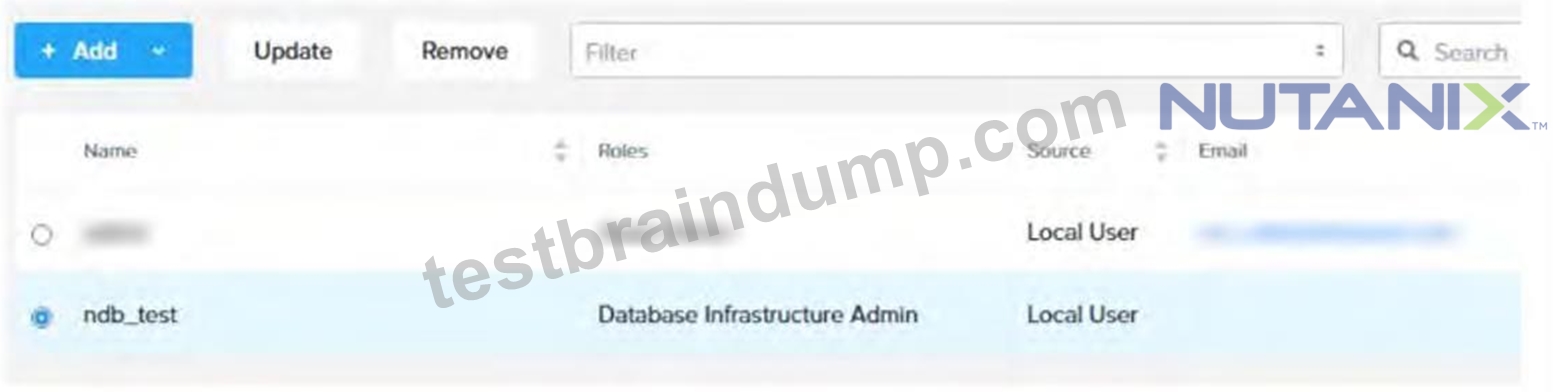
- A. NDB Configuration
- B. Network Profiles
- C. Clones
- D. Access Control
Answer: A,C
Explanation:
The exhibit shows the NDB user management interface with a newly created user named
"ndb_test" assigned the "Database Infrastructure Admin" role and sourced as a "Local User." In NDB, the "Database Infrastructure Admin" role grants specific permissions, allowing the user to manage database-related tasks such as creating, managing, and deleting clones, as well as performing configuration tasks within the NDB environment (e.g., updating settings or managing database servers). However, this role does not extend to higher-level administrative functions like Access Control or Network Profiles, which are reserved for roles with broader administrative privileges (e.g., System Administrator).
NEW QUESTION # 155
What are two status values that can be set within the Alerts Dashboard? (Choose two.)
- A. Resolved
- B. Data Resiliency
- C. Acknowledged
- D. Auto
Answer: A,C
Explanation:
The correct answer is B and D because these are the two status values that can be set within the Alerts Dashboard in NDB. Resolved means that the alert has been fixed and no longer requires attention. Acknowledged means that the alert has been seen and is being worked on. Option A is incorrect because Auto is not a status value, but a mode that automatically resolves alerts based on predefined rules. Option C is incorrect because Data Resiliency is not a status value, but a feature that ensures the availability and integrity of the data in NDB.
NEW QUESTION # 156
What must be completed within NDB before patching a Linux OS?
- A. Update the software profile version.
- B. Configure database high availability.
- C. Configure the repository.
- D. Update the database.
Answer: C
Explanation:
Before patching a Linux OS on a database server VM provisioned using NDB, you must configure the repository for the OS updates. This can be done by creating a Repository Profile in NDB and specifying the URL, username, and password for the repository. The Repository Profile can be applied to one or more database server VMs during the provisioning process or later. By configuring the repository, you ensure that NDB can access and download the latest OS patches from a trusted source.
NEW QUESTION # 157
An administrator needs to make new VLANs available when provisioning a Oracle cluster database, which have been added to NDB via the Administration menu. What needs to be done to expose the new VLANs for provisioning?
- A. Create a new Network Profile with the new VLANs.
- B. Update Prism Element with the new VLAN and discover it in NDB.
- C. Update the Network Profile to include the new VLANs.
- D. Create a new VLAN in Prism Element and discover it in NDB.
Answer: C
Explanation:
A Network Profile is a collection of network settings that are used to provision database server VMs in NDB. A Network Profile can include one or more VLANs, IP ranges, and DNS servers. To make new VLANs available when provisioning an Oracle cluster database, you need to update the Network Profile to include the new VLANs. You can do this by editing the existing Network Profile or creating a new one with the new VLANs. You do not need to create or update the VLANs in Prism Element, as NDB can discover the VLANs configured in AHV.
NEW QUESTION # 158
Nutanix NDB gives an administrator the ability to create highly-available database pairs with which two databases? (Choose two.)
- A. MySQL
- B. PostgreSQL
- C. SQL Server
- D. MariaDB
Answer: B,C
Explanation:
Nutanix NDB provides the ability to create highly-available (HA) database pairs, leveraging replication and failover across clusters. The two databases explicitly supported for HA pairs in NDB are PostgreSQL and SQL Server. NDB orchestrates HA for PostgreSQL using streaming replication and for SQL Server using Always On Availability Groups or Failover Cluster Instances, ensuring data redundancy and failover capabilities across Nutanix clusters.
NEW QUESTION # 159
Before registering a database server VM to NDB, what should an administrator use to verify all required software and configuration dependencies?
- A. LCM
- B. NCC
- C. Prerequisites script
- D. Upgrade Software
Answer: C
Explanation:
Before registering a database server VM to NDB, an administrator must verify that all required software (e.g., database engine, OS dependencies) and configuration settings (e.g., WinRM for Windows, SSH for Linux) are in place. NDB provides a prerequisites script, which can be run on the target VM to check these dependencies automatically. This script ensures compatibility and readiness, reducing registration failures.
NEW QUESTION # 160
The NDB user interface can display which language option?
- A. Korean
- B. German
- C. French
- D. Japanese
Answer: D
Explanation:
The NDB user interface supports multiple languages, including English, Chinese, and Japanese.
You can change the language pReference: in the NDB settings page. The NDB user interface does not support Korean, French, or German languages at this time.
NEW QUESTION # 161
A DBA executed a script which corrupted an Oracle DB managed by NDB. After few minutes, the NDB administrator has been asked to create a copy of the DB using the latest available snapshot.
Which actions should be taken?
- A. Select the snapshot from Time Machine and create a new clone.
- B. Use Time Machine to create a clone from file-level database backup.
- C. Provision a new Oracle DB and perform log catch-up.
- D. Fail the Oracle cluster over to a surviving RAC node.
Answer: A
Explanation:
After a DBA's script corrupts an Oracle DB managed by NDB, the administrator needs to restore a clean copy using the latest available snapshot. The most straightforward action is to use the NDB Time Machine feature to select the most recent uncorrupted snapshot and create a new clone. This clone can serve as a restored version of the database, bypassing the corrupted data while leveraging existing snapshots for efficiency.
NEW QUESTION # 162
While using Time Machine (TM) to restore a source database, the option to restore data to Point in Time is not available. What should an administrator do to restore databases to Point in Time?
- A. Update TM SLA to BRONZE or higher.
- B. Update TM SLA to BRASS or lower.
- C. Restore Source DB using a snapshot
- D. Create DB clone using a snapshot.
Answer: A
Explanation:
In Nutanix Database Service (NDB), the Time Machine (TM) feature allows restores, including Point-in-Time (PIT) restores, which require continuous log retention to replay transaction logs to a specific moment. If the option to restore data to a Point in Time is unavailable, it indicates that the current Time Machine Service Level Agreement (SLA) does not support continuous log retention.
NDB SLAs are categorized (e.g., BRONZE, SILVER, GOLD), with BRONZE or higher levels required to enable PIT restore by including continuous log retention. The administrator must update the TM SLA to at least BRONZE to enable this feature, ensuring logs are retained for PIT operations.
NEW QUESTION # 163
Which ports must be open between the NDB server and Controller VMs to facilitate iSCSI connections?
- A. 22 and 9440
- B. 80 and 443
- C. 5985 and 5986
- D. 3205 and 3260
Answer: D
Explanation:
According to the Nutanix Database Automation (NCP-DB) course, the ports 3205 and 3260 are required for iSCSI connections between the NDB server and the Controller VMs. Port 3205 is used for the NDB iSCSI initiator service, which initiates the iSCSI sessions and sends SCSI commands to the Controller VMs. Port 3260 is used for the iSCSI target service, which listens for incoming iSCSI requests and provides access to the storage devices on the Controller VMs. The other options are not related to iSCSI connections. Port 22 is used for SSH, port 9440 is used for Prism Central, port 80 is used for HTTP, port 443 is used for HTTPS, port 5985 is used for WinRM HTTP, and port 5986 is used for WinRM HTTPS.
NEW QUESTION # 164
An administrator created an NDB managed VLAN called PGSQLVLAN40 After deploying PostgreSQL HA, it was noticed that the databases were able to communicate with everything on VLAN 40 only. What can the administrator do to fix the current issue and going forward?
- A. Use VLAN 1 for the PostgreSQL deployment.
- B. Engage the networking team as this is a network related issue.
- C. Delete the data base servers, VLAN name PGSQLVLAN40 and redeploy the same information under a different VLAN name.
- D. Change the Default Gateway on the PostgreSQL servers and update NDB for VLAN PGSQLVLAN40.
Answer: B
Explanation:
The scenario describes a PostgreSQL HA deployment managed by NDB, where an NDB- managed VLAN (PGSQLVLAN40) restricts database communication to only within VLAN 40. This indicates a network isolation issue, likely due to VLAN segmentation or routing misconfiguration, preventing communication with external networks or other VLANs. Since NDB manages the VLAN and assigns it to the database VMs, the issue lies beyond NDB's direct control and involves the underlying network infrastructure (e.g., switches, routers, or Prism Element network settings).
NEW QUESTION # 165
For supported Linux based database VM's managed by NDB, how would an administrator keep software profiles updated for provisioning new database VMs?
- A. Apply patches to a database VM for each supported database engine, then create a new software profile version for each supported database VM for each one using the updated database VM as the source.
- B. Associate the newly provisioned database VMs with a maintenance window so they are keep updated.
- C. Create a Maintenance window under the policy menu, then under Database VM, add the database VMs to that maintenance window and check both Database and Operating system updates.
- D. In the Administrator menu drop down, go the Maintenance tab and choose Download Upgrade
Answer: A
Explanation:
For supported Linux-based database VMs managed by NDB, keeping software profiles updated for provisioning new database VMs requires a structured process. The administrator must first apply the necessary patches (e.g., OS updates and database engine patches) to an existing database VM for each supported database engine (e.g., PostgreSQL, Oracle). Then, a new software profile version must be created using the updated VM as the source. This new version captures the patched configuration and can be used to provision new VMs, ensuring they are deployed with the latest updates.
NEW QUESTION # 166
How long is the default continuous recovery for the Gold SLA in Era Time Machine?
- A. 90 days
- B. 60 days
- C. 15 days
- D. 30 days
Answer: D
Explanation:
The default continuous recovery for the Gold SLA in Era Time Machine is 30 days. This means that the system keeps a continuous recovery point for the last 30 days, allowing you to restore your database to any point within this period.
NEW QUESTION # 167
A database administrator wants to define initialization variables for different types of database engines and workloads, like OLTP and DW.
What type of profile would be used?
- A. Software Profile Version
- B. Database Parameters
- C. Compute
- D. Network
Answer: B
Explanation:
The database parameters profile is used to define the initialization variables for different types of database engines and workloads, such as OLTP and DW. The database parameters profile allows the database administrator to customize the configuration settings for each database engine, such as Oracle, SQL Server, PostgreSQL, and MySQL. The database parameters profile can also be applied to different database operations, such as provisioning, cloning, and patching.
The database parameters profile helps to optimize the performance and functionality of the databases according to the specific requirements and best practices of each database engine and workload. The software profile version is used to define the software version and edition for each database engine, such as Oracle 19c Enterprise Edition or SQL Server 2019 Standard Edition. The software profile version is required for provisioning new databases and patching existing databases. The software profile version helps to ensure the compatibility and compliance of the databases with the supported software versions and editions.
The network profile is used to define the network configuration and security settings for the database server VMs and the databases, such as the IP address, subnet mask, gateway, DNS, firewall rules, and SSL certificates. The network profile is required for registering new database server VMs and provisioning new databases. The network profile helps to ensure the connectivity and protection of the database server VMs and the databases within the network environment.
The compute profile is used to define the compute resources and storage policies for the database server VMs and the databases, such as the CPU, memory, disk size, disk type, compression, deduplication, and replication factor. The compute profile is required for provisioning new databases and cloning existing databases. The compute profile helps to ensure the availability and efficiency of the database server VMs and the databases within the Nutanix cluster.
NEW QUESTION # 168
An administrator needs to patch a PostgreSQL database server VM from version 13.4 to 13.8.
What is the first step within the NDB patching workflow to accomplish this task?
- A. Create a Software Profile Version with PostgreSQL 13.8.
- B. Create a new Software Profile with PostgreSQL 13.8.
- C. Create a maintenance window and add this PostgreSQL server 13.8 to the queue.
- D. Create a new Database Parameters profile for PostgreSQL server 13.8.
Answer: A
Explanation:
NDB supports patching for PostgreSQL database instances. Patching for PostgreSQL is validated on VMs provisioned by NDB (greenfield deployments). To patch PostgreSQL database server VMs, you must create a software profile version by uploading the PostgreSQL update file in NDB. You can then use the PostgreSQL update to patch other database server VMs or provision a new database server VM with the updated software profile. The first step in the NDB patching workflow is to create a software profile version with the desired PostgreSQL version.
NEW QUESTION # 169
An administrator needs to provision a 3-node MSSQL Server AG with the following configuration:
- Two database server VMS including the primary replica on a local site
- A third database server VM on a remote site
How many IP addresses will the network at each site require?
- A. 2 Cluster VIP and 1 listener IP on the local site
- B. 1 Cluster VIP end I Listener IP on the local site
1 Listener IP on the local site
2 IPs in the local site and I on the remote site for the database server nodes - C. 1 Cluster VIP end I Listener IP on the local site
1 Cluster VIP and 1 Listener IP on the remote site
2 IPs in the local site and 1 on the remote site for the database server nodes - D. 1 Cluster VIP and 1 listener IP on the remote site
2 IPs in the local site and 1 on the remote site for the database server nodes
1 Cluster VIP on the local site
1 Cluster VIP and 1 Listener IP on the remote site
2 IPs in the local site and 1 on the remote site for the database server nodes
Answer: C
Explanation:
When setting up a 3-node MSSQL Server AG with two database server VMs on a local site and a third database server VM on a remote site, the network at each site will require the following IP addresses:
1 Cluster VIP and 1 Listener IP on the local site.
1 Cluster VIP and 1 Listener IP on the remote site.
2 IPs in the local site and 1 on the remote site for the database server nodes.
This configuration ensures that each node in the cluster has a unique IP address, and each cluster and listener also has a unique IP address. This is necessary for the proper functioning of the cluster and to ensure that all nodes can communicate with each other and with clients.
NEW QUESTION # 170
A database administrator wants to clone an SQL database that has Transparent Data Encryption (TDE) enabled.
Which two steps must be taken on the target server for this clone to be successful? (Choose two.)
- A. Backup the .cer and .pvk files from the source database server VM.
- B. Run the post-clone command script.
- C. Backup the keystore bundle file from the source database server VM.
- D. Run the pre-clone command script.
Answer: B,C
Explanation:
When cloning an SQL database with Transparent Data Encryption (TDE) enabled in NDB, the target server must handle the encryption keys to ensure the cloned database remains functional and secure. TDE uses a keystore (e.g., a bundle file containing the master key and certificate) to encrypt data. Two steps are required: (1) The administrator must back up the keystore bundle file from the source database server VM and transfer it to the target server, ensuring the clone can decrypt the data. (2) After the clone is created, the administrator must run the post-clone command script, which configures the TDE keys on the target server, completes the encryption setup, and activates the cloned database.
NEW QUESTION # 171
An administrator has run into an error when provisioning a new Oracle database VM. What is the best action that the administrator should perform in the NDB GUI to provide the most complete picture to send to Nutanix support on that specific operation?
- A. Take a screen shot of the error in the Operations menu.
- B. Copy the error message from the Operations menu.
- C. From the Administration section of NDB. go to the Diagnostics section and chose Generate Bundle.
- D. In the operations menu, select the job the failed and choose Generate Bundle from the lower right.
Answer: D
Explanation:
When an administrator encounters an error provisioning a new Oracle database VM in NDB, the best action to provide Nutanix support with the most complete picture is to select the failed job in the Operations menu and choose Generate Bundle from the lower right. The "Generate Bundle" option creates a comprehensive diagnostic package, including logs, configuration details, and error traces specific to the failed operation. This bundle is ideal for troubleshooting and can be uploaded to Nutanix Support for analysis.
NEW QUESTION # 172
An administrator has applied an Oracle security patch to a database server VM registered in Era.
How do you make this change available to other existing database instances?
- A. Create a n.. software profile version from the patched VM.
- B. Merge the changes into an existing software profile.
- C. Register the VM as a have' database server VM and then create a software profile using this newly registered VIVI.
- D. Create a new software profile in Era from the patched VM.
Answer: D
Explanation:
Nutanix Database Service (NDB) uses software profiles for database patching to keep your databases secure and optimized. When a new database is provisioned, it will be on your current environment's database version to maintain consistency and stop version sprawl. Therefore, after an administrator has applied an Oracle security patch to a database server VM registered in Era, the change can be made available to other existing database instances by creating a new software profile in Era from the patched VM.
NEW QUESTION # 173
What is required to cre110ate a network profile in Era?
- A. The network must provide IP address management.
- B. The network must be added to Era.
- C. The network must contain static IP addresses.
- D. The network must be managed by Era.
Answer: B
Explanation:
According to the Nutanix Database Automation (NCP-DB) learning documents, to create a network profile in Era, the network must be added to Era. This is because Era needs to have control over the network in order to manage the databases effectively. Once the network is added to Era, it can be used for various operations such as provisioning new databases, managing existing databases, and more.
NEW QUESTION # 174
An administrator is looking to provision a relational database management system (RDBMS) in an HA instance. Which two database engines are supported with NDB? (Choose two.)
- A. MongoDB
- B. PostgreSGL
- C. Oracle
- D. MariaDB
Answer: B,C
Explanation:
Nutanix Database Service (NDB) supports high availability (HA) instances for certain relational database management systems (RDBMS). Among the listed options, NDB natively supports Oracle and PostgreSQL for HA configurations, enabling features like replication and failover.
These databases are well-integrated with NDB's Time Machine and HA frameworks.
NEW QUESTION # 175
......
NCP-DB-6.10 Exam Questions – Valid NCP-DB-6.10 Dumps Pdf: https://quiztorrent.testbraindump.com/NCP-DB-6.10-exam-prep.html
