
Latest Microsoft DP-700 Dumps for success in Actual Exam Jan-2026]
Realistic DP-700 100% Pass Guaranteed Download Exam Q&A
NEW QUESTION # 26
You have a Fabric workspace that contains a warehouse named Warehouse1.
While monitoring Warehouse1, you discover that query performance has degraded during the last 60 minutes.
You need to isolate all the queries that were run during the last 60 minutes. The results must include the username of the users that submitted the queries and the query statements. What should you use?
- A. views from the queryinsights schema
- B. Query activity
- C. the Microsoft Fabric Capacity Metrics app
- D. the sys.dm_exec_requests dynamic management view
Answer: A
NEW QUESTION # 27
Your company has a team of developers. The team creates Python libraries of reusable code that is used to transform data.
You create a Fabric workspace name Workspace1 that will be used to develop extract, transform, and load (ETL) solutions by using notebooks.
You need to ensure that the libraries are available by default to new notebooks in Workspace1.
Which three actions should you perform in sequence? To answer, move the appropriate actions from the list of actions to the answer area and arrange them in the correct order.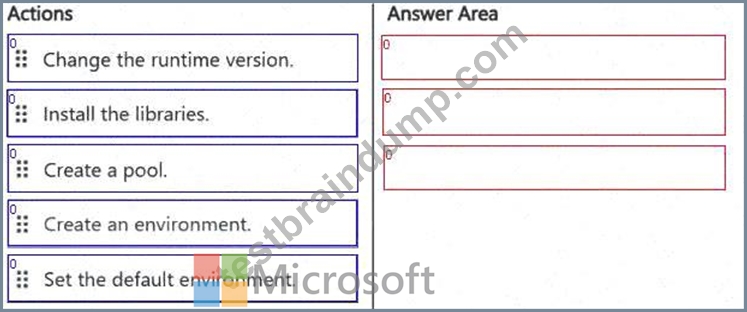
Answer:
Explanation: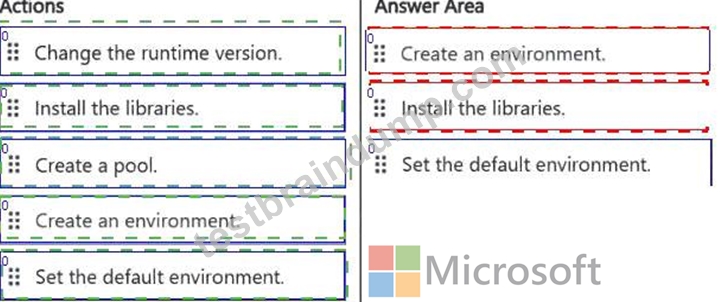
Explanation: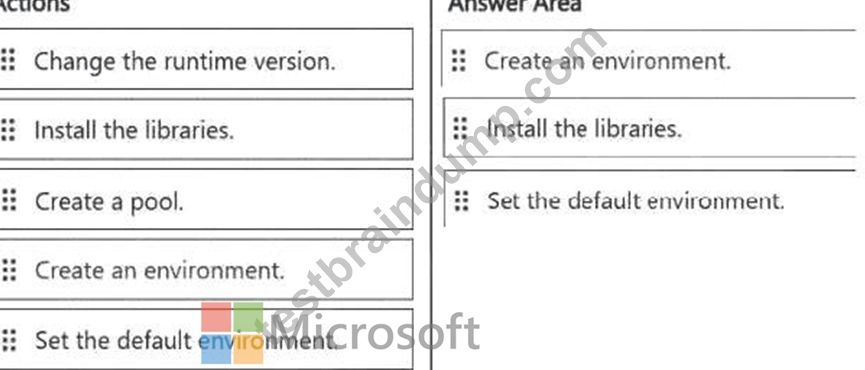
NEW QUESTION # 28
You need to populate the MAR1 data in the bronze layer.
Which two types of activities should you include in the pipeline? Each correct answer presents part of the solution.
NOTE: Each correct selection is worth one point.
- A. WebHook
- B. Copy data
- C. Stored procedure
- D. ForEach
Answer: B,D
Explanation:
MAR1 has seven entities, each accessible via a different API endpoint. A ForEach activity is required to iterate over these endpoints to fetch data from each one. It enables dynamic execution of API calls for each entity.
The Copy data activity is the primary mechanism to extract data from REST APIs and load it into the bronze layer in Delta format. It supports native connectors for REST APIs and Delta, minimizing development effort.
NEW QUESTION # 29
HOTSPOT
You are building a data loading pattern for Fabric notebook workloads.
You have the following code segment: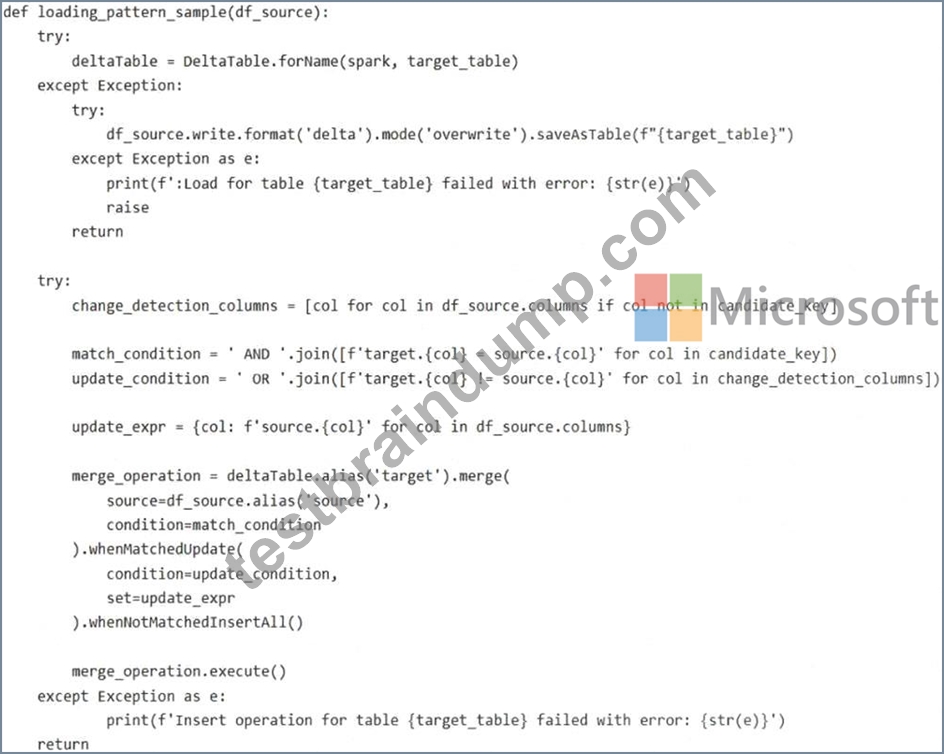
For each of the following statements, select Yes if the statement is true. Otherwise, select No.
NOTE: Each correct selection is worth one point.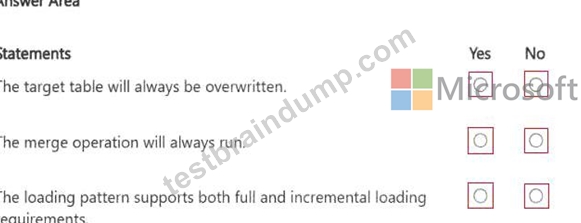
Answer:
Explanation: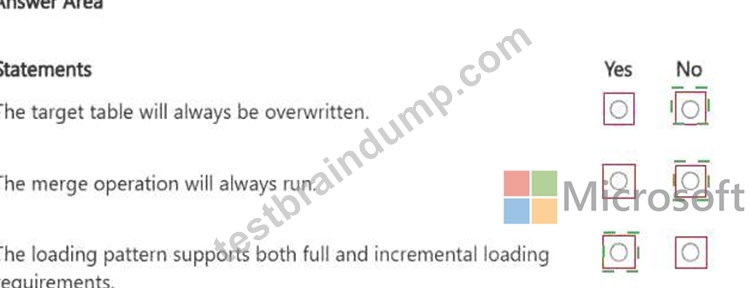
Explanation: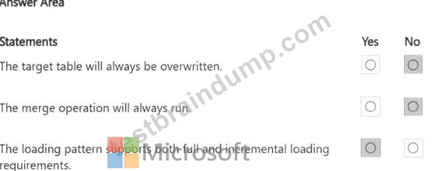
NEW QUESTION # 30
You are building a data loading pattern by using a Fabric data pipeline. The source is an Azure SQL database that contains 25 tables. The destination is a lakehouse.
In a warehouse, you create a control table named Control.Object as shown in the exhibit. (Click the Exhibit tab.) You need to build a data pipeline that will support the dynamic ingestion of the tables listed in the control table by using a single execution.
Which three actions should you perform in sequence? To answer, move the appropriate actions from the list of actions to the answer area and arrange them in the correct order.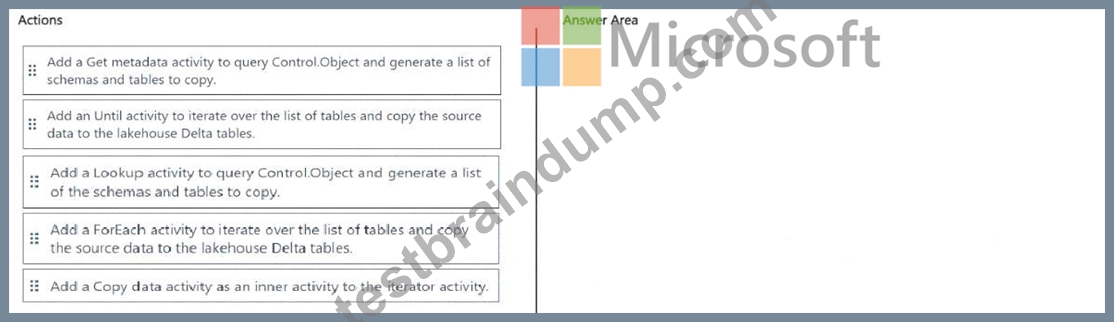
Answer:
Explanation: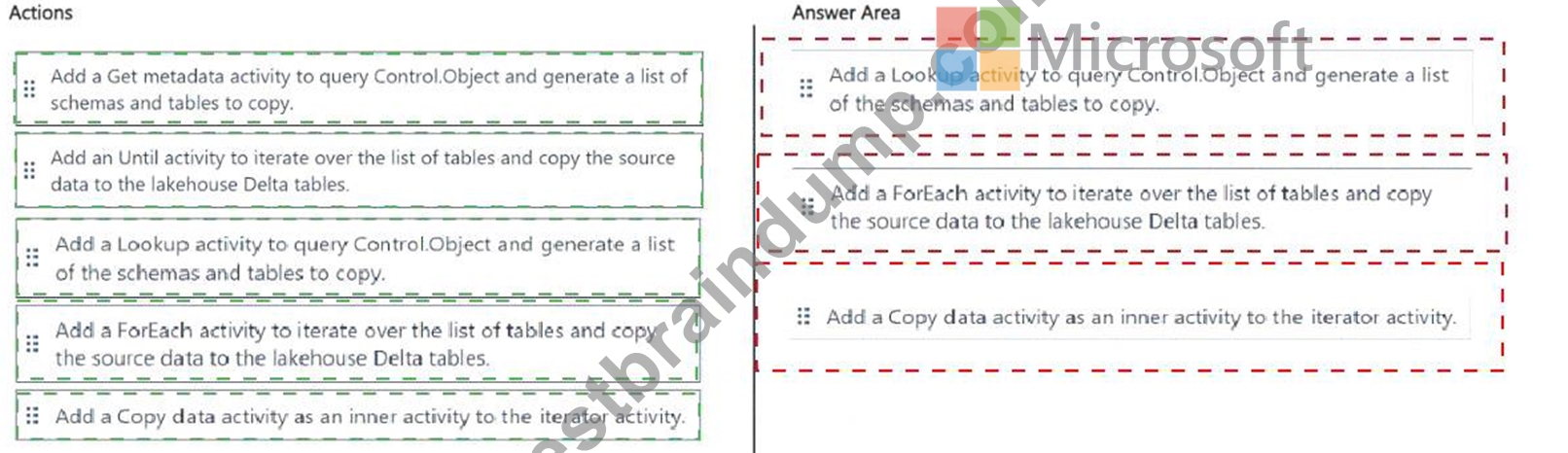
Explanation: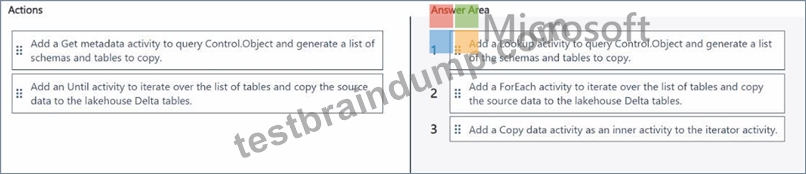
NEW QUESTION # 31
You need to ensure that the data analysts can access the gold layer lakehouse.
What should you do?
- A. Share the lakehouse with the DataAnalysts group and grant the Read all SQL Endpoint data permission.
- B. Share the lakehouse with the DataAnalysts group and grant the Read all Apache Spark permission.
- C. Add the DataAnalyst group to the Viewer role for WorkspaceA.
- D. Share the lakehouse with the DataAnalysts group and grant the Build reports on the default semantic model permission.
Answer: A
Explanation:
Data Analysts' Access Requirements must only have read access to the Delta tables in the gold layer and not have access to the bronze and silver layers.
The gold layer data is typically queried via SQL Endpoints. Granting the Read all SQL Endpoint data permission allows data analysts to query the data using familiar SQL-based tools while restricting access to the underlying files.
NEW QUESTION # 32
You have a Fabric notebook named Notebook1 that has been executing successfully for the last week.
During the last run, Notebook1executed nine jobs.
You need to view the jobs in a timeline chart.
What should you use?
- A. Spark History Server
- B. the run series from the details of the application run
- C. Real-Time hub
- D. Monitoring hub
- E. the job history from the application run
Answer: B
Explanation:
The run series from the details of the application run is the most detailed and relevant feature for visualizing job execution in a timeline format, making it the correct choice for this scenario. It provides an intuitive way to analyze job execution patterns and improve the efficiency of the notebook.
NEW QUESTION # 33
You have three users named User1, User2, and User3.
You have the Fabric workspaces shown in the following table.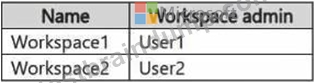
You have a security group named Group1 that contains User1 and User3.
The Fabric admin creates the domains shown in the following table.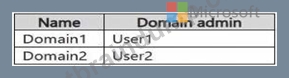
User1 creates a new workspace named Workspace3.
You add Group1 to the default domain of Domain1.
For each of the following statements, select Yes if the statement is true. Otherwise, select No.
NOTE: Each correct selection is worth one point.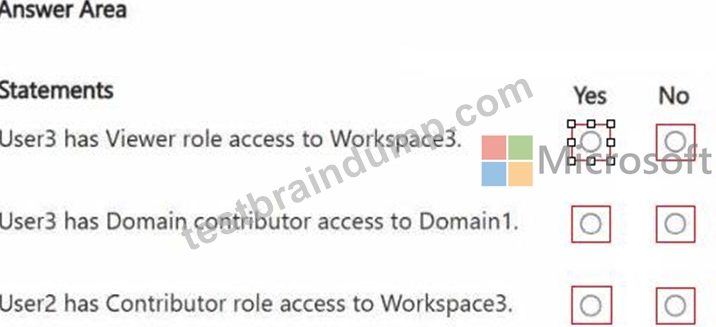
Answer:
Explanation: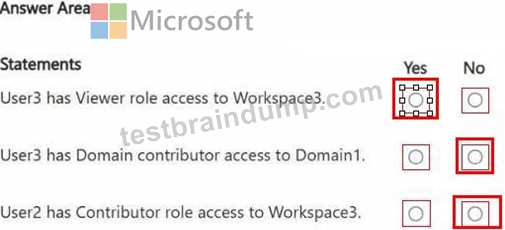
NEW QUESTION # 34
HOTSPOT
You have a Fabric workspace named Workspace1_DEV that contains the following items:
10 reports
Four notebooks
Three lakehouses
Two data pipelines
Two Dataflow Gen1 dataflows
Three Dataflow Gen2 dataflows
Five semantic models that each has a scheduled refresh policy
You create a deployment pipeline named Pipeline1 to move items from Workspace1_DEV to a new workspace named Workspace1_TEST.
You deploy all the items from Workspace1_DEV to Workspace1_TEST.
For each of the following statements, select Yes if the statement is true. Otherwise, select No.
NOTE: Each correct selection is worth one point.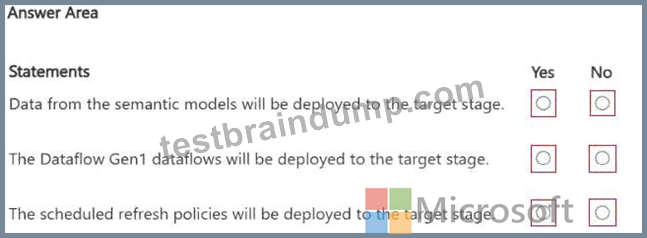
Answer:
Explanation: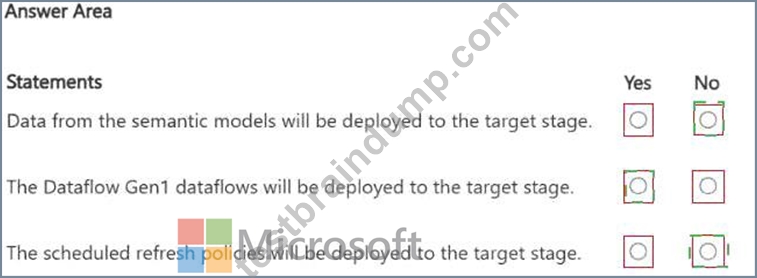
Explanation: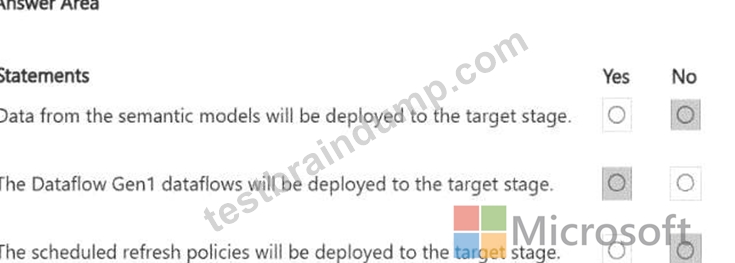
NEW QUESTION # 35
Note: This question is part of a series of questions that present the same scenario. Each question in the series contains a unique solution that might meet the stated goals. Some question sets might have more than one correct solution, while others might not have a correct solution.
After you answer a question in this section, you will NOT be able to return to it. As a result, these questions will not appear in the review screen.
You have a KQL database that contains two tables named Stream and Reference. Stream contains streaming data in the following format.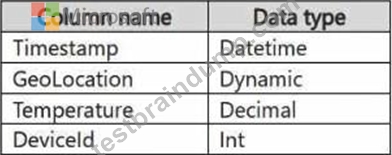
Reference contains reference data in the following format.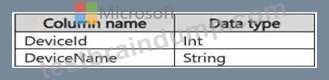
Both tables contain millions of rows.
You have the following KQL queryset.
You need to reduce how long it takes to run the KQL queryset.
Solution: You add the make_list() function to the output columns.
Does this meet the goal?
- A. No
- B. Yes
Answer: A
Explanation:
Adding an aggregation like make_list() would require additional processing and memory, which could make the query slower.
NEW QUESTION # 36
You have a Fabric capacity that contains a workspace named Workspace1. Workspace1 contains a lakehouse named Lakehouse1, a data pipeline, a notebook, and several Microsoft Power BI reports.
A user named User1 wants to use SQL to analyze the data in Lakehouse1.
You need to configure access for User1. The solution must meet the following requirements:
What should you do?
- A. Share Lakehouse1 with User1 directly and select Build reports on the default semantic model.
- B. Assign User1 the Viewer role for Workspace1. Share Lakehouse1 with User1 and select Read all SQL endpoint data.
- C. Assign User1 the Member role for Workspace1. Share Lakehouse1 with User1 and select Read all SQL endpoint data.
- D. Share Lakehouse1 with User1 directly and select Read all SQL endpoint data.
Answer: B
Explanation:
To meet the specified requirements for User1, the solution must ensure:
Read access to the table data in Lakehouse1: User1 needs permission to access the data within Lakehouse1. By sharing Lakehouse1 with User1 and selecting the Read all SQL endpoint data option, User1 will be able to query the data via SQL endpoints.
Prevent Apache Spark usage: By sharing the lakehouse directly and selecting the SQL endpoint data option, you specifically enable SQL-based access to the data, preventing User1 from using Apache Spark to query the data.
Prevent access to other items in Workspace1: Assigning User1 the Viewer role for Workspace1 ensures that User1 can only view the shared items (in this case, Lakehouse1), without accessing other resources such as notebooks, pipelines, or Power BI reports within Workspace1.
This approach provides the appropriate level of access while restricting User1 to only the required resources and preventing access to other workspace assets.
NEW QUESTION # 37
You have a Fabric warehouse named DW1 that contains four staging tables named ProductCategory, ProductSubcategory, Product, and SalesOrder. ProductCategory, ProductSubcategory, and Product are used often in analytical queries.
You need to implement a star schema for DW1. The solution must minimize development effort.
Which design approach should you use? To answer, select the appropriate options in the answer area.
NOTE: Each correct selection is worth one point.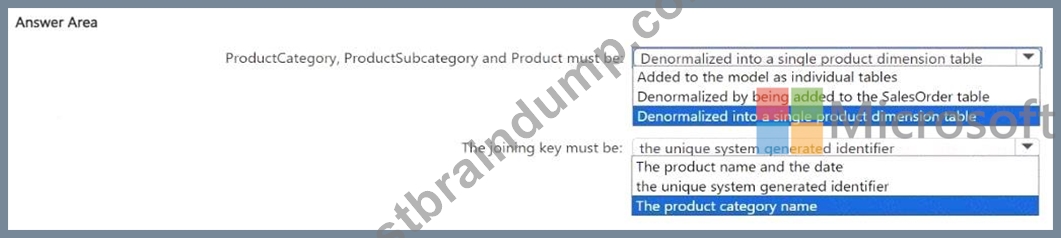
Answer:
Explanation: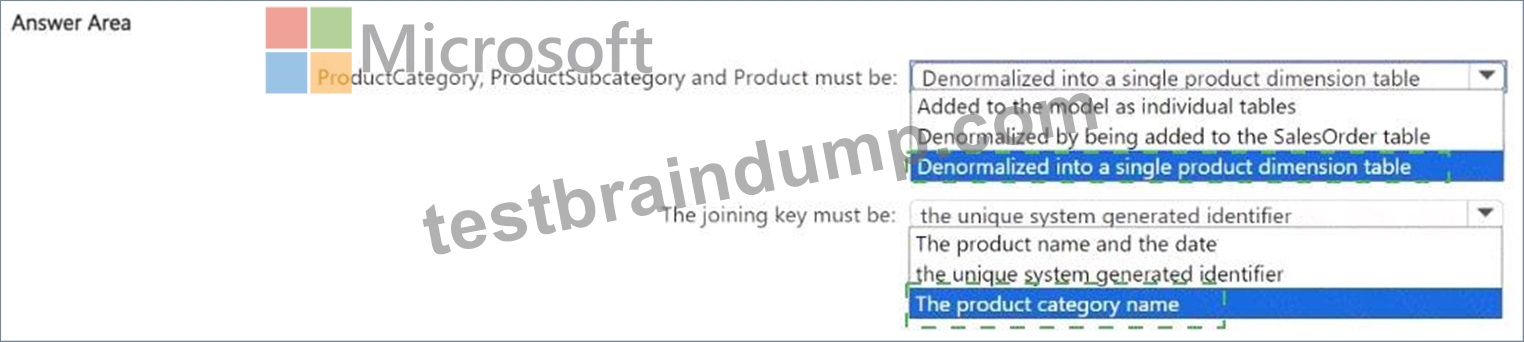
Explanation:
NEW QUESTION # 38
You have a Fabric workspace that contains a data pipeline named Pipeline! as shown in the exhibit.
(Click the Exhibit tab.) What will occur the next time Pipelinel tuns?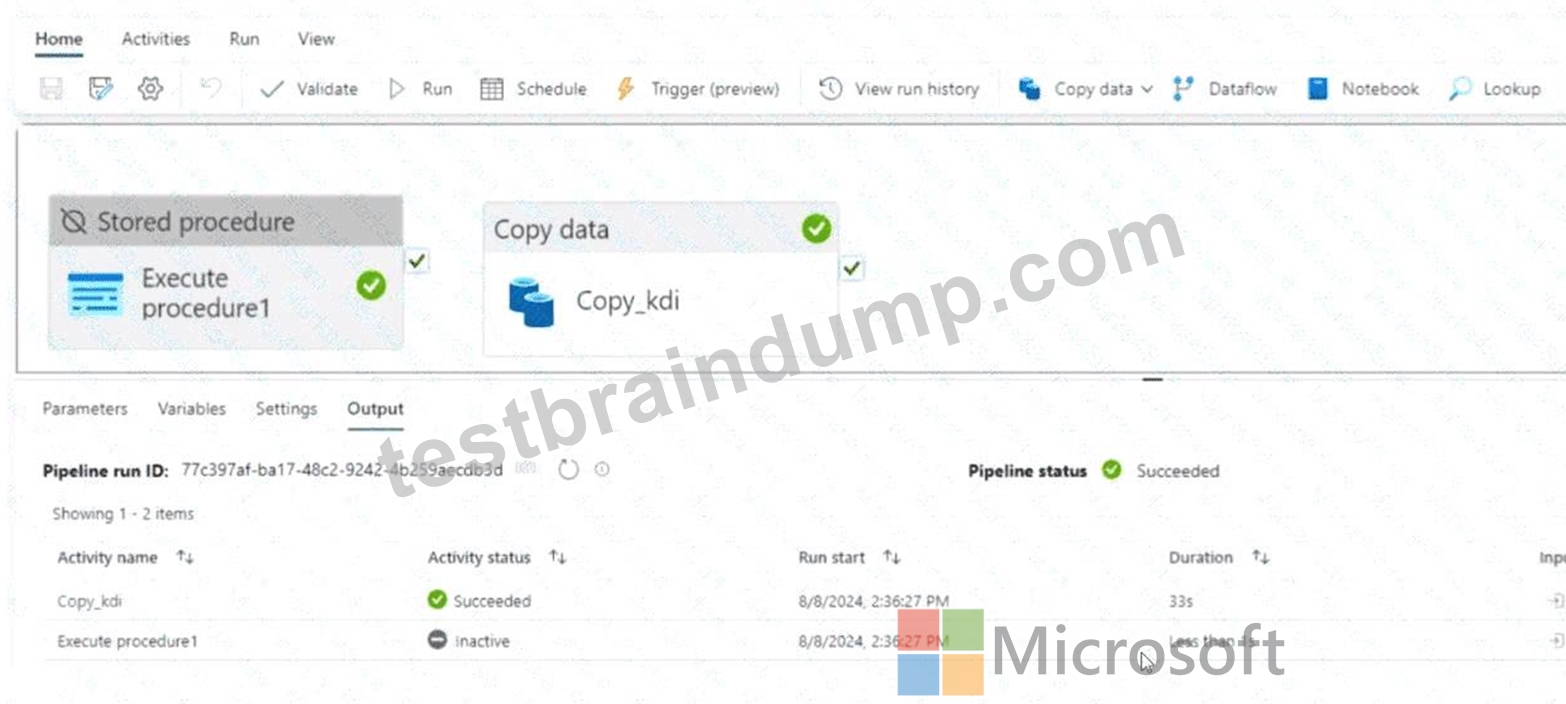
- A. Copy.kdi will run and Execute procedurel will be skipped.
- B. Execute procedurel will run and Copy_kdi will be skipped.
- C. Copy.kdi will run first, and then Execute procedurel will run.
- D. Both activities will run simultaneously.
- E. Execute procedure1 will run first, and then Copy_kdi will run.
- F. Both activities will be skipped.
Answer: A
NEW QUESTION # 39
HOTSPOT
You are processing streaming data from an external data provider.
You have the following code segment.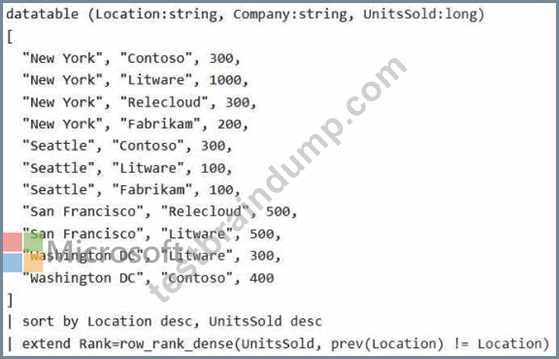
For each of the following statements, select Yes if the statement is true. Otherwise, select No.
NOTE: Each correct selection is worth one point.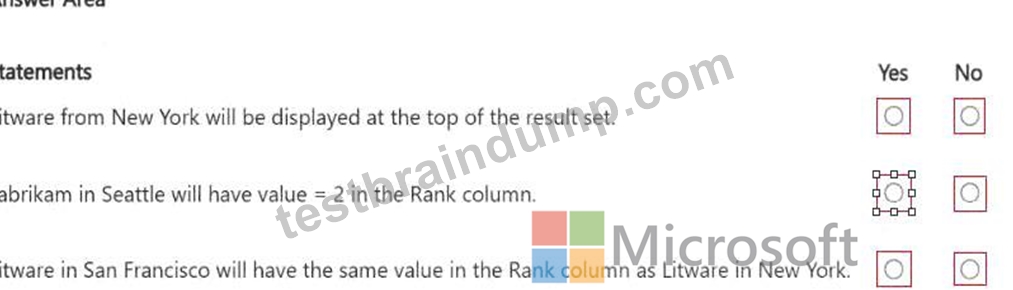
Answer:
Explanation: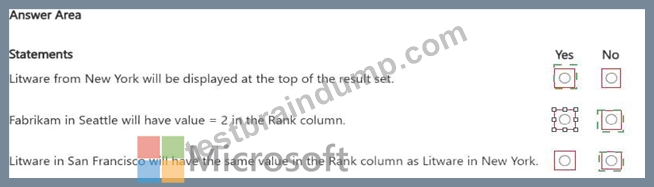
Explanation: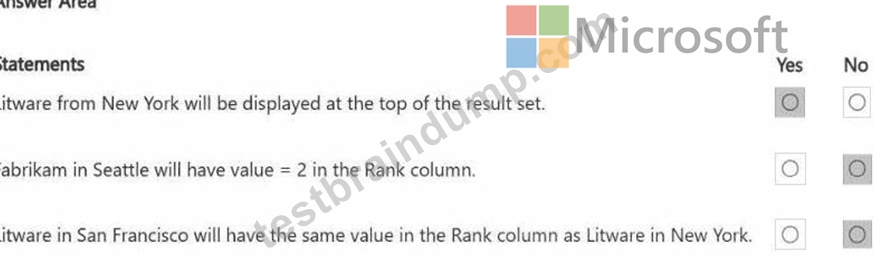
Litware from New York will be displayed at the top of the result set - Yes The data is sorted first by Location in descending order and then by UnitsSold in descending order. Since
"New York" is alphabetically the last Location, it will appear first in the result set. Within "New York", Litware has the highest UnitsSold (1000), so it will be displayed at the top.
Fabrikam in Seattle will have value = 2 in the Rank column - No
The row_rank_dense function assigns dense ranks based on UnitsSold within each location. In "Seattle":
Contoso has UnitsSold = 300 # Rank 1
Litware has UnitsSold = 100 # Rank 2
Fabrikam also has UnitsSold = 100, so it shares the same rank (2) as Litware.
Litware in San Francisco will have the same value in the Rank column as Litware in New York - No The rank is calculated separately for each location. In "San Francisco":
Both Relecloud and Litware have UnitsSold = 500, so they share the same rank (1).
In "New York", Litware has the highest UnitsSold = 1000 # Rank 1.
Since ranks are calculated independently for each location, Litware in San Francisco does not share the same rank as Litware in New York.
NEW QUESTION # 40
You have a Fabric warehouse named DW1 that contains four staging tables named ProductCategory, ProductSubcategory, Product, and SalesOrder. ProductCategory, ProductSubcategory, and Product are used often in analytical queries.
You need to implement a star schema for DW1. The solution must minimize development effort.
Which design approach should you use? To answer, select the appropriate options in the answer area.
NOTE: Each correct selection is worth one point.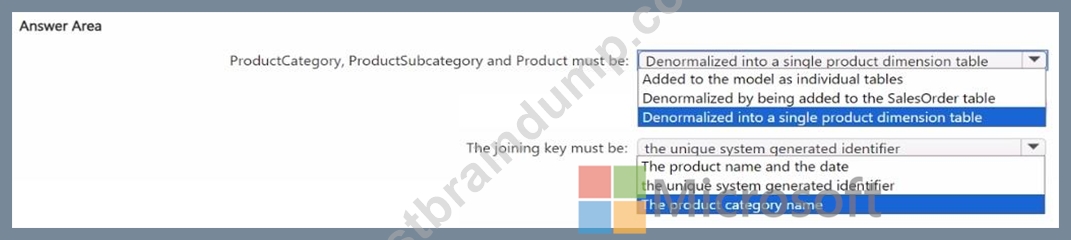
Answer:
Explanation: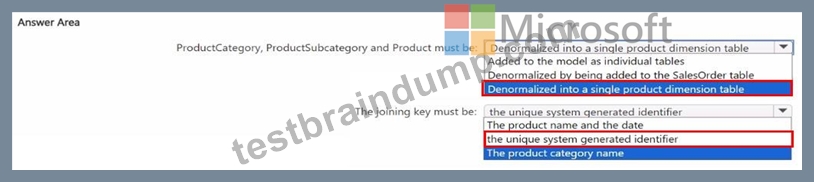
NEW QUESTION # 41
......
Microsoft DP-700 Exam Syllabus Topics:
| Topic | Details |
|---|---|
| Topic 1 |
|
| Topic 2 |
|
| Topic 3 |
|
Accurate DP-700 Answers 365 Days Free Updates: https://quiztorrent.testbraindump.com/DP-700-exam-prep.html
